
You confirm the order. The supplier accepts the specifications. The deposit is paid. The factory gives you a production date.
Everything appears locked.
Then, a few days later, the supplier says:
“Production will start one week later than planned.”
For an importer with inventory forecasts, customer commitments, marketing campaigns, or shipping deadlines, even a small change can create serious problems.
But a confirmed production date is not always an unchangeable guarantee. Manufacturing schedules depend on materials, components, tooling, labor, machinery, customer approvals, upstream suppliers, and other orders already moving through the factory.
Understanding why production dates move helps importers distinguish normal manufacturing variability from poor supplier management—and gives them more control over the schedule.
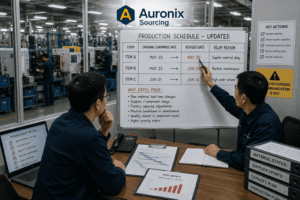
A Production Date Is Part of a Larger Factory Schedule
Your purchase order does not exist in isolation.
Most factories are simultaneously managing orders from multiple customers.
Production planners must coordinate:
- Production lines
- Machines
- Workers
- Tooling
- Materials
- Testing equipment
- Packaging capacity
Your order receives a place within this larger schedule.
If something changes elsewhere in the system, your production window can also be affected.
Material Delays Can Push the Start Date
One of the most common reasons for schedule changes is material availability.
Before manufacturing begins, the factory may need to purchase:
- Plastic resin
- Metal
- Fabric
- Electronic components
- Hardware
- Packaging materials
If an upstream supplier delivers late, production may not be able to start as planned.
Even one missing critical component can stop an otherwise complete order.
This is why material readiness should be monitored before the scheduled production date.
Custom Components Create Additional Risk
Standard components may be readily available.
Customized components can require their own production cycle.
Examples might include:
- Custom batteries
- Specialized hardware
- Printed components
- Custom fabrics
- Electronic modules
Your main supplier therefore depends on another manufacturer’s schedule.
When that upstream supplier moves its date, your factory may have little choice but to adjust yours.
Late Sample Approval Can Cost the Production Slot
Factories cannot always begin purchasing materials or setting up production until the final sample is approved.
If the buyer takes longer than expected to approve the sample, the original production window may become unavailable.
The factory may schedule another customer’s order into that capacity.
When approval finally arrives, your order could move to the next available slot.
This is why buyers should treat approval deadlines as part of the production schedule.
Packaging Approval Can Cause the Same Problem
A product may be ready while its packaging is not.
Delays can occur because of:
- Artwork revisions
- Incorrect dimensions
- Color corrections
- Translation changes
- Regulatory labeling
Custom packaging may be manufactured by a separate supplier.
If approval is late, packaging production starts late, potentially affecting final completion.
Last-Minute Changes Can Reset the Schedule
Changing specifications after confirmation can have larger consequences than buyers expect.
A seemingly simple change such as a new color might require:
- Different material
- New sample approval
- Packaging changes
- Production setup adjustments
More significant changes can require new tooling or components.
Once the order changes, the factory may need to recalculate both cost and production timing.
The original date was based on the original specification.
Another Order May Run Longer Than Expected
Factories schedule production sequentially.
If the customer ahead of you experiences problems, your order can be affected.
For example, the previous production run may encounter:
- Equipment problems
- Lower-than-expected output
- Quality issues
- Rework
If both orders require the same line, the delay can move downstream.
This is similar to an aircraft arriving late and affecting its next scheduled flight.
Machine Breakdowns Can Change Capacity
Manufacturing equipment requires maintenance and occasionally fails unexpectedly.
A breakdown involving critical equipment can reduce available capacity.
The factory may need to:
- Repair the machine
- Move production
- Reschedule orders
Factories with redundant equipment may recover quickly.
A manufacturer depending heavily on one specialized machine can be more vulnerable.
This is one reason factory capacity should be evaluated beyond headline production numbers.
Tooling Problems Can Delay Production
Custom products may depend on molds, dies, fixtures, or jigs.
Before mass production, tooling may require:
- Adjustment
- Repair
- Maintenance
- Additional validation
If the first production units reveal tooling-related defects, the factory may stop production and correct the issue.
A short delay at this stage may be preferable to manufacturing thousands of defective units.
Quality Problems Can Stop the Line
A factory should not continue producing products known to be outside agreed specifications simply to maintain a promised date.
If early production reveals problems involving:
- Dimensions
- Appearance
- Assembly
- Functionality
- Materials
production may need to stop while the root cause is investigated.
This can move the completion date.
From the buyer’s perspective, the key question is whether the factory identifies and communicates the issue quickly.
Worker Availability Can Affect Scheduling
Some manufacturing processes depend on skilled labor.
Unexpected workforce shortages can reduce production output.
This can be particularly important around major holiday periods when factories and suppliers may experience workforce changes.
Factories may respond through overtime, additional shifts, or worker reallocation, but these options have limits.
Peak Season Changes Factory Capacity
A production date that appears easy to achieve during a quiet month may become difficult during peak season.
Factories can face simultaneous pressure from:
- Increased orders
- Material shortages
- Supplier congestion
- Labor constraints
- Packaging demand
The entire manufacturing ecosystem becomes busier.
Importers should therefore plan important seasonal orders earlier rather than relying on normal lead times.
Chinese New Year Can Affect More Than the Holiday
Manufacturing disruption around Chinese New Year can extend beyond official factory closure dates.
Before the holiday, factories may face:
- Heavy order backlogs
- Worker departures
- Supplier shutdowns
Afterward, operations may require time to return to normal capacity.
Buyers sourcing around this period should include substantial scheduling buffers and confirm timelines carefully.
An Urgent Customer Can Affect the Schedule
Factories sometimes receive high-priority requests from important customers.
They may respond by:
- Adding overtime
- Rearranging production
- Using alternative lines
A professionally managed factory should still protect existing commitments where possible.
However, during periods of limited capacity, commercial priorities can influence scheduling.
This is another reason long-term supplier relationships can matter.
Subcontractors Can Cause Delays
Many factories outsource specialized processes such as:
- Printing
- Plating
- Surface treatment
- Heat treatment
- Component manufacturing
Your supplier may therefore be waiting for an external company before production can continue.
Ask which critical processes are outsourced when evaluating manufacturing risk.
The factory’s schedule is only as reliable as important upstream partners.
Testing Can Become a Bottleneck
Production can appear complete while products wait for required testing.
A factory may have limited equipment for:
- Functional testing
- Electrical testing
- Performance testing
- Leak testing
If multiple orders require the same testing resources, a queue can develop.
The expected completion date should therefore reflect the full production process rather than assembly alone.
The Factory May Have Overbooked Capacity
Not every moved production date has an unavoidable technical explanation.
Sometimes factories simply accept more orders than they can realistically handle.
This can happen when sales teams promise aggressive lead times without confirming production capacity.
Repeated schedule changes can therefore indicate weaknesses in:
- Capacity planning
- Internal communication
- Production management
One delay does not necessarily make a supplier unreliable.
A consistent pattern deserves closer attention.
A Deposit Does Not Automatically Reserve Immediate Capacity
Buyers sometimes assume:
Deposit paid = production begins immediately.
That is not necessarily true.
The factory may still need to complete:
Material Procurement → Production Queue → Setup → Manufacturing
Before paying, clarify the expected production start and completion dates.
For time-sensitive orders, also ask what conditions must be completed before the production slot is considered confirmed.
Ask for Milestones, Not One Date
Instead of relying only on:
“Ready in 30 days.”
request visibility into important milestones.
For example:
- Materials ordered
- Materials received
- Planned production start
- Production completion
- Packaging completion
- Final inspection readiness
Milestones make delays easier to identify before the final deadline is missed.
Confirm Material Readiness Before Production
Several days before the planned start, ask whether critical materials and components are ready.
If they are not, investigate immediately.
This can reveal a likely delay before the scheduled production date arrives.
For strategically important orders, production monitoring can provide additional visibility.
Keep Buyer Approvals Organized
Importers should also control the parts of the schedule they influence.
Track deadlines for:
- Sample approval
- Artwork
- Colors
- Packaging
- Specifications
Respond quickly and document approvals clearly.
If the factory is waiting for the buyer, production scheduling becomes increasingly difficult to protect.
Avoid Unnecessary Changes After Confirmation
Once specifications are approved and materials are ordered, changes become expensive.
If a modification is essential, ask the supplier to confirm its impact on:
- Cost
- Materials
- Tooling
- Production date
Do not assume a small product change creates a small scheduling change.
Build Time Buffers Into Inventory Planning
Production dates should not be treated as perfectly predictable.
Professional inventory planning considers possible variation in:
- Manufacturing
- Inspection
- Rework
- Shipping
- Customs
The appropriate buffer depends on the product and supply chain.
Businesses operating with almost no inventory margin can turn relatively small manufacturing delays into stockouts.
Keep a Qualified Backup Supplier
If production timing is strategically important, supplier diversification can reduce dependency.
A backup manufacturer should ideally already be:
- Verified
- Sampled
- Commercially evaluated
Switching factories still takes time, especially for custom products.
But having a qualified alternative provides significantly more flexibility than beginning a supplier search during an emergency.
How Auronix Sourcing Helps Manage Production Schedules
Auronix Sourcing helps businesses maintain greater visibility between order confirmation and finished production.
Support can include supplier capacity evaluation, specification and sample coordination, material follow-up, production scheduling, factory communication, production monitoring, factory visits, quality inspection, packaging coordination, backup supplier development, shipment consolidation, and international shipping coordination.
Rather than waiting until the expected completion date to discover a problem, Auronix can help monitor key production milestones so potential delays can be identified earlier.
Conclusion
A confirmed production date can move because manufacturing depends on an interconnected system of materials, components, machines, tooling, workers, subcontractors, packaging suppliers, customer approvals, and factory capacity.
Some schedule changes are legitimate consequences of manufacturing complexity.
Others can indicate poor planning or factory overbooking.
The difference becomes easier to understand when buyers monitor production milestones instead of relying on one promised completion date.
Finalize specifications early, approve samples and packaging promptly, confirm material readiness, plan ahead for peak seasons, maintain inventory buffers, and qualify alternative suppliers for critical products.
With Auronix Sourcing, businesses can coordinate factory schedules, monitor production progress, manage quality inspections, develop backup suppliers, and organize international logistics—helping reduce surprises between order confirmation and shipment.