
For many importers, the production schedule seems like an internal factory issue.
The buyer places an order, pays the agreed deposit, receives a lead time, and expects the finished products to be ready by the promised date.
But manufacturing does not work like a simple countdown.
Factories must coordinate materials, components, machinery, tooling, workers, subcontractors, quality control, packaging, and multiple customer orders at the same time. Your purchase order becomes one part of that larger production system.
That is why understanding the factory production schedule matters. It affects when manufacturing actually begins, when inspection can happen, when cargo can ship, and ultimately when inventory reaches your warehouse.
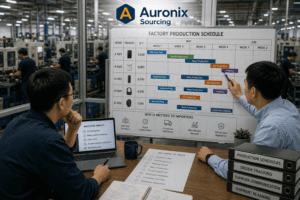
Production Lead Time Is Not the Same as Production Time
Suppose a supplier quotes a 30-day production lead time.
That does not necessarily mean your product requires 30 continuous days on a production line.
The timeline may include:
Material Procurement → Production Queue → Setup → Manufacturing → Assembly → Testing → Packaging
The product itself might require only several days of active manufacturing.
The rest of the lead time comes from preparation and scheduling.
This distinction is important when planning inventory.
Your Order May Not Start Immediately
Paying a deposit does not automatically mean machines begin running the next morning.
The factory may still need to:
- Purchase materials
- Receive components
- Complete sample approval
- Prepare tooling
- Wait for production capacity
If another customer’s order already occupies the required line, yours may enter a queue.
Importers should therefore clarify both the planned production start date and the expected completion date.
Factories Serve Multiple Customers
Most established manufacturers handle several customer orders simultaneously.
These orders compete for resources such as:
- Production lines
- Machines
- Skilled workers
- Testing equipment
- Packaging capacity
Production planners must decide how those resources are allocated.
This means another customer’s delay, urgent order, or extended production run can sometimes affect your schedule.
Materials Determine When Production Can Begin
A factory cannot manufacture products without the required inputs.
Depending on the order, it may need to secure:
- Plastics
- Metals
- Fabrics
- Electronic components
- Hardware
- Packaging
Standard materials may already be available.
Custom materials can require additional procurement time.
If one critical component arrives late, the planned production start may move even when every other material is ready.
Customization Adds Scheduling Complexity
Customized products usually require more coordination than standard catalog products.
Custom production might involve:
- New tooling
- Special materials
- Custom colors
- Printing
- Private labeling
- Custom packaging
Each activity can involve separate suppliers and approval stages.
The more customized the product, the more important production scheduling becomes.
Tooling Must Be Available
Products requiring molds, dies, jigs, or fixtures depend on tooling availability and condition.
Before production, the factory may need to:
- Install tooling
- Calibrate equipment
- Conduct trial runs
- Check initial output
If tooling requires adjustment or repair, the production start can be affected.
For custom manufacturing, tooling preparation should therefore be considered part of the production schedule.
Buyer Approvals Affect the Schedule
Importers can unintentionally create their own delays.
Factories may be waiting for approval of:
- Samples
- Artwork
- Colors
- Packaging
- Specifications
If approval arrives late, the factory cannot always keep the original production slot empty.
Another customer’s order may be scheduled into that capacity.
When the buyer finally approves everything, the next available slot could be later.
Fast and organized decision-making helps protect production schedules.
Last-Minute Changes Can Move Production
Once materials are purchased and capacity is scheduled, design changes can become disruptive.
A modification may require:
- New materials
- Different components
- Revised samples
- Tooling adjustments
- Packaging changes
The factory then needs to reassess both cost and timing.
A small change from the buyer’s perspective can have a much larger effect inside the manufacturing process.
Production Schedules Affect Inventory
This is where factory planning becomes directly connected to business performance.
Imagine your warehouse has six weeks of inventory remaining.
You expect:
- 4 weeks production
- 3 weeks shipping
Your total replenishment cycle is already approximately seven weeks before considering inspections, customs, or unexpected delays.
If production starts two weeks late, a stockout becomes much more likely.
Production scheduling should therefore feed directly into inventory planning.
Production Schedules Affect Marketing
Inventory and marketing cannot be planned independently.
A company might schedule:
- Product launches
- Influencer campaigns
- Advertising
- Seasonal promotions
based on an expected inventory arrival.
If production moves, those campaigns may begin before enough stock exists.
Businesses should avoid making irreversible marketing commitments based only on optimistic supplier estimates.
Production Schedules Affect Freight Bookings
International shipping also requires planning.
Once production completion is reasonably predictable, logistics teams can coordinate appropriate freight arrangements.
If production is delayed, planned cargo movement may also need to change.
Depending on the shipping method and route, this can affect:
- Freight timing
- Availability
- Final delivery
Manufacturing and logistics should therefore be treated as connected stages of one supply chain.
Quality Inspection Needs Scheduling Too
Pre-shipment inspection cannot happen effectively if production is not sufficiently complete.
The buyer or inspection provider needs a realistic date when the goods will be ready.
If the factory repeatedly moves completion, inspection arrangements may also need to move.
This can create additional delays before shipment.
Accurate production scheduling therefore supports better quality-control planning.
Packaging Has Its Own Schedule
A product can finish manufacturing while still being unable to ship.
Custom packaging may include:
- Retail boxes
- Labels
- Inserts
- Protective materials
- Master cartons
These items may come from external packaging suppliers.
Packaging should be prepared alongside production rather than left until the finished goods are waiting.
Subcontractors Affect the Timeline
Many factories outsource certain operations.
Examples can include:
- Printing
- Plating
- Surface finishing
- Heat treatment
- Specialized components
The final factory’s production schedule therefore depends partly on other businesses.
A delay at a subcontractor can move the completion date even when the main factory itself is operating normally.
Bottlenecks Can Change the Schedule
A factory’s advertised monthly capacity does not necessarily represent its finished-product output.
One stage may become a bottleneck.
For example:
Molding: 20,000/day
Assembly: 8,000/day
Packaging: 12,000/day
Assembly may effectively determine the production rate.
Understanding bottlenecks helps importers evaluate whether quoted lead times are realistic.
Peak Season Makes Scheduling Harder
During high-demand periods, factories receive more orders while material and component suppliers become busier.
Production slots can fill much earlier.
Lead times may increase before:
- Major retail seasons
- Seasonal demand peaks
- Chinese New Year
Importers should not assume that a lead time achieved during a quiet month will remain available throughout the year.
Chinese New Year Requires Special Planning
Chinese New Year can affect manufacturing before and after official factory closures.
Potential issues include:
- Workers leaving early
- Suppliers closing
- Production backlogs
- Slow restart after the holiday
Orders scheduled too close to this period can face significant timing uncertainty.
Planning should consider the entire supply chain rather than only the final factory’s official holiday dates.
A Factory Can Be Capable but Fully Booked
This distinction is essential.
A supplier may have excellent:
- Equipment
- Quality systems
- Engineering
- Production capability
but still be unable to meet your required timeline because its capacity is already committed.
Supplier selection should therefore evaluate both manufacturing capability and capacity availability.
Ask Better Scheduling Questions
Instead of asking only:
“How long is production?”
ask more specific questions:
- When can materials be ready?
- When is the planned production start?
- Is the required line currently available?
- When should mass production finish?
- When will packaging be complete?
- When can final inspection occur?
These questions create much better visibility into the real timeline.
Track Production Milestones
Once the order is confirmed, monitor progress through key stages.
A simple sequence might be:
Order Confirmed → Materials Ready → Production Started → Production Completed → Packaging Completed → Inspection Ready
If one milestone moves, the buyer can evaluate the impact before the final delivery deadline is missed.
Waiting until day 30 to ask whether a 30-day order is finished provides very little time to solve problems.
Use Realistic Inventory Buffers
No production schedule is perfectly predictable.
Factories can experience:
- Material delays
- Equipment problems
- Quality rework
- Capacity constraints
Importers should therefore maintain appropriate inventory and scheduling buffers.
The required buffer depends on product demand, lead time, seasonality, and supply-chain risk.
Forecasting Can Help Secure Capacity
Repeat buyers can share realistic forecasts with suppliers.
For example, informing the factory about expected quarterly order volumes may help it anticipate future requirements.
Forecasting can support discussions about:
- Material planning
- Production capacity
- Seasonal orders
Forecasts should be credible rather than exaggerated.
Reliable information creates more value than promises of unrealistic future volume.
Maintain a Backup Supplier
Even good production planning cannot eliminate every risk.
For important products, a qualified secondary manufacturer can provide additional flexibility.
The backup supplier should ideally already be:
- Verified
- Sampled
- Commercially evaluated
Finding an alternative only after the primary factory misses production is much more difficult.
How Auronix Sourcing Helps Manage Production Schedules
Auronix Sourcing helps businesses coordinate manufacturing schedules as part of the wider sourcing process.
Support can include supplier capacity evaluation, specification and sample coordination, material and component follow-up, production scheduling, factory communication, production monitoring, factory visits, quality inspection, packaging coordination, backup supplier development, shipment consolidation, and international shipping coordination.
By tracking important milestones between order confirmation and shipment, Auronix helps importers gain greater visibility into whether production is progressing according to plan.
Conclusion
Factory production schedules matter because they connect almost every stage of the import process.
They influence material purchasing, manufacturing, quality inspection, packaging, freight planning, inventory availability, and product launches.
A quoted lead time alone does not provide enough visibility.
Professional importers understand when materials will be ready, when production is scheduled to begin, what could create bottlenecks, when inspection can occur, and how much buffer exists before inventory is required.
The objective is not to eliminate every possible delay. Manufacturing will always contain some variability.
The objective is to identify scheduling risk early enough to manage it.
With Auronix Sourcing, businesses can coordinate supplier capacity, monitor production milestones, manage quality inspections, develop backup suppliers, and organize international logistics—helping create a more predictable path from purchase order to finished inventory.