
General suppliers can be extremely useful during the early stages of an ecommerce business.
When a brand is testing products, ordering small quantities, or selling across several unrelated categories, a general supplier can provide flexibility. Instead of building relationships with multiple specialized factories, the business can source different products through one contact.
But this convenience has limits.
As a product becomes successful and order volumes increase, the sourcing requirements usually become more demanding. Quality consistency, customization, pricing transparency, production capacity, packaging, technical development, and supply-chain control become increasingly important.
At that point, continuing to rely on a general supplier may create hidden costs.
The important question is not whether general suppliers are good or bad. It is whether the current sourcing structure still matches the needs of the business.
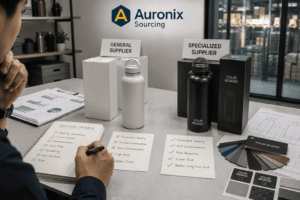
What Is a General Supplier?
A general supplier typically offers products across multiple categories rather than specializing deeply in one manufacturing process or product family.
Depending on the business model, it may operate as a:
- Trading company
- Wholesaler
- Sourcing intermediary
- Multi-category supplier
- Distributor
For ecommerce businesses testing multiple products, this can be practical.
One supplier may help source home products, pet accessories, kitchen items, beauty tools, and other categories without the buyer managing many separate relationships.
Why Ecommerce Brands Start With General Suppliers
Early-stage ecommerce businesses often prioritize:
Speed + Flexibility + Low Complexity
A general supplier may offer:
- Access to multiple products
- Smaller quantities
- Easier communication
- Consolidated purchasing
- Simple logistics coordination
This can reduce operational workload while the business is still discovering which products have genuine demand.
There is little value in building a complex factory network for products that may disappear from the catalog after a few months.
General Suppliers Can Be Excellent for Product Testing
Suppose an ecommerce brand wants to test ten products.
Finding, verifying, sampling, and managing ten different factories may consume significant time.
A capable general supplier can make the testing phase easier.
The brand can gather sales data first.
Once one or two products become proven winners, the sourcing strategy can change.
This is often where specialized sourcing begins creating greater value.
Sign 1: Your Order Volume Has Increased Significantly
The first major signal is volume.
A general supplier may work perfectly at:
500 units per order
But once the business begins ordering:
5,000 → 10,000 → 30,000 units
the economics change.
At larger volumes, relatively small differences in unit cost become financially meaningful.
A $0.20 difference across 500 units equals:
$100
Across 30,000 units:
$6,000
At scale, it becomes increasingly important to understand the underlying manufacturing structure.
Sign 2: You Do Not Know Who Actually Manufactures the Product
Ask:
Who is making our product?
If the answer remains unclear after repeated large orders, visibility may be insufficient.
The general supplier may be buying from:
- A factory
- Another trading company
- A wholesaler
- Multiple factories
This does not automatically mean the arrangement is unreliable.
However, growing brands often need greater control over manufacturing capability, quality systems, production capacity, and changes to the product.
Sign 3: Quality Becomes Inconsistent
Quality variation is one of the strongest reasons to investigate the supply chain.
Suppose:
Order 1: Excellent
Order 2: Acceptable
Order 3: Different finish
Order 4: Increased defects
One possible explanation is that production sources changed.
If the intermediary moves orders between factories depending on price or capacity, product consistency can become difficult to maintain.
The buyer should determine whether production is coming from the same approved manufacturer.
Sign 4: The Supplier Cannot Explain Quality Problems
When defects occur, ask technical questions.
A strong manufacturing partner should be able to investigate:
Defect → Production Process → Root Cause → Corrective Action
If every response is simply:
“Factory will be more careful next time,”
the supplier may lack sufficient technical visibility or influence over production.
As order value increases, vague corrective actions become increasingly risky.
Sign 5: You Need Product Customization
A generic product may be enough during market testing.
Successful ecommerce brands often eventually want differentiation through:
- Materials
- Dimensions
- Colors
- Components
- Features
- Branding
- Packaging
This requires deeper manufacturing cooperation.
A specialized manufacturer may provide stronger technical knowledge for OEM, ODM, or private-label development.
Sign 6: Product Development Is Becoming Technical
The more complex the product becomes, the more valuable direct manufacturing expertise becomes.
Imagine developing an improved product requiring changes to:
- Tooling
- Components
- Materials
- Assembly
A general supplier may need to relay every question to another company.
That creates a communication chain:
Buyer → General Supplier → Factory → Engineer
and back again.
Technical information can become slower or distorted.
Sign 7: Your Prices Stop Looking Competitive
General suppliers need to earn money.
Their margin is compensation for services such as sourcing, coordination, communication, consolidation, or financing.
That margin is not automatically a problem.
The question is whether the total value remains competitive.
Once purchasing volume becomes significant, benchmark the current price against qualified manufacturing alternatives.
Do not assume that “factory direct” automatically means cheaper, either. Compare the complete commercial arrangement.
Sign 8: Price Changes Are Difficult to Explain
Suppose your supplier announces:
“Price increased 12% because material cost increased.”
Ask for context.
A transparent supply relationship should make major commercial changes reasonably understandable.
If pricing frequently changes without clear explanations, direct supplier benchmarking can help determine whether increases reflect market conditions or the existing sourcing structure.
Sign 9: MOQ Is Preventing Growth
General suppliers can sometimes offer low MOQs because they aggregate products from existing supply channels.
But the opposite can also occur.
As your product becomes customized, you may face MOQs from multiple upstream suppliers involving:
- Materials
- Components
- Packaging
A specialized sourcing process can identify where those MOQs actually originate and whether alternatives exist.
Sign 10: You Need Better Payment Terms
As order values grow, payment timing becomes increasingly important.
A business purchasing $5,000 per order has different working-capital requirements from one purchasing $200,000.
Long-term relationships with verified manufacturers may create opportunities to discuss different commercial structures as purchasing history develops.
Payment flexibility is never guaranteed, but it becomes a more important sourcing consideration at scale.
Sign 11: Production Scheduling Is Becoming Critical
A general supplier may tell you:
“Production will finish next month.”
A scaling brand may need much more visibility.
It may need to know:
Materials Ready → Production Start → Assembly → Packaging → Inspection Ready
This information supports inventory planning and product launches.
If your existing supplier cannot provide reliable milestone visibility, deeper factory-level management may become necessary.
Sign 12: Delays Keep Appearing Without Warning
Delays happen in manufacturing.
The more important issue is transparency.
If your supplier repeatedly reports delays only after deadlines are missed, you may lack sufficient production visibility.
Direct production monitoring can provide earlier warning of:
- Material shortages
- Capacity problems
- Packaging delays
This becomes increasingly valuable as inventory exposure grows.
Sign 13: You Need Better Quality Control
Quality requirements often become stricter as a brand grows.
The business may begin using:
- Detailed specifications
- Golden samples
- Defect classifications
- Inspection checklists
- Corrective-action systems
These controls work best when the actual manufacturer understands and implements them consistently.
If instructions are repeatedly lost between intermediaries, the sourcing structure may need to change.
Sign 14: You Cannot Audit the Actual Factory
For important or high-volume products, businesses may want to evaluate manufacturing conditions and capabilities directly.
If your supplier cannot identify or provide appropriate access to the manufacturing facility, consider whether that level of opacity remains acceptable for your business risk.
Factory verification becomes more valuable as purchasing exposure increases.
Sign 15: Your Packaging Is Becoming More Sophisticated
Growing brands often move beyond basic packaging.
They may require:
- Custom boxes
- Inserts
- Printed manuals
- Barcodes
- Retail-ready packaging
Packaging development requires coordination between the product manufacturer, packaging supplier, designers, and quality-control teams.
A sourcing structure that cannot manage these details efficiently may begin limiting the brand.
Sign 16: You Need Better Traceability
When an ecommerce business sells a few hundred units, traceability may appear less important.
At scale, businesses may need to connect:
Customer Complaint → SKU → Batch → Purchase Order → Factory
If the actual manufacturer is unclear, root-cause analysis becomes much harder.
Greater supplier transparency improves traceability.
Sign 17: You Are Expanding Into Multiple Markets
International expansion can introduce additional requirements involving:
- Product configurations
- Packaging
- Labels
- Languages
- Documentation
- Applicable regulations
A multi-market sourcing program requires strong version control.
If the general supplier cannot reliably manage different market configurations, a more structured manufacturing network may be necessary.
Sign 18: One Product Now Generates Most of Your Revenue
A general supplier may still make sense for dozens of experimental products.
But imagine one product now generates 60% of company revenue.
That SKU has become strategically important.
The business should understand:
- Who manufactures it
- Where critical components come from
- What production capacity exists
- What quality systems are used
- What backup options exist
A critical revenue product deserves greater supply-chain visibility.
Do Not Remove the General Supplier Just to Remove a Middleman
Businesses sometimes assume:
Middleman = unnecessary cost
That is too simplistic.
A capable intermediary may provide real value through:
- Supplier communication
- Consolidation
- Quality coordination
- Logistics
- Local problem solving
If these services save more than they cost, the relationship may remain commercially attractive.
Evaluate total value, not simply the number of companies between you and the factory.
Compare Total Supplier Cost
Before changing your sourcing structure, calculate the full cost.
Suppose:
General Supplier Price: $8.00
Factory Price: $7.50
The apparent saving is $0.50.
But direct factory sourcing may create additional requirements involving:
- Supplier management
- Inspection
- Consolidation
- Communication
- Logistics coordination
The correct comparison is:
Total Current Sourcing Cost vs. Total Alternative Sourcing Cost
not simply quotation versus quotation.
Consider a Hybrid Sourcing Model
The choice does not have to be:
General Supplier OR Direct Factory
A growing ecommerce brand can use different sourcing models simultaneously.
For example:
New Product Tests → General Supplier
Proven High-Volume Products → Specialized Manufacturer
Custom Products → OEM/ODM Factory
This allows flexibility without sacrificing control over strategic products.
Transition Gradually
Do not move your best-selling product to a new factory simply because the quotation is cheaper.
A safer transition may involve:
Supplier Search → Verification → Sample → Testing → Factory Audit if Required → Trial Order → Quality Inspection → Scale
This produces real evidence before major volume is transferred.
Keep a Backup During the Transition
Where practical, avoid immediately terminating the existing supply route.
You might initially allocate:
Existing Supplier: 70%
New Manufacturer: 30%
If the new factory performs well, production can gradually shift.
The exact approach depends on the product, tooling, order size, and commercial circumstances.
Measure the New Supplier Using Data
The new factory should be evaluated using the same KPIs as the existing supplier.
Track:
- Defect rate
- Inspection performance
- Lead time
- Delivery reliability
- Cost
- Communication
- Corrective action
Do not assume the new supplier is automatically better because it is a manufacturer.
Performance must be demonstrated.
When Should You Stay With a General Supplier?
Continuing with a general supplier may make sense when:
- Volumes remain small
- Products change frequently
- The supplier provides strong consolidation
- Quality remains consistent
- Pricing remains competitive
- Customization is limited
- The supplier provides valuable local support
The objective is not to reach the factory at all costs.
The objective is to build the most effective sourcing structure for the business.
When Should You Move Toward Specialized Factories?
The case becomes stronger when several conditions appear simultaneously:
Volume ↑
Customization ↑
Quality Requirements ↑
Need for Traceability ↑
Need for Capacity Visibility ↑
Supplier Costs ↑
Product Strategic Importance ↑
At that point, the convenience of a general supplier may no longer compensate for reduced manufacturing visibility.
How Auronix Sourcing Helps Ecommerce Brands Transition
Auronix Sourcing helps ecommerce businesses move from basic product purchasing toward more structured manufacturer sourcing in China.
Support can include supplier discovery, manufacturer verification, factory audits and visits, RFQ management, quotation comparison, sample development, OEM and ODM coordination, private labeling, commercial negotiation, production monitoring, quality inspection, packaging development, corrective-action follow-up, backup supplier development, shipment consolidation, and international shipping coordination.
For businesses that still benefit from multi-supplier purchasing, Auronix can also help coordinate sourcing and consolidation without requiring the brand to manage every factory independently.
Conclusion
An ecommerce brand should not stop using a general supplier simply because it has grown.
It should reconsider the relationship when the existing sourcing model begins limiting cost control, quality, customization, production visibility, traceability, capacity, or scalability.
General suppliers can be excellent for:
Testing → Variety → Small Orders → Convenience
Specialized manufacturers become increasingly valuable for:
Scale → Customization → Technical Control → Quality Consistency → Production Visibility
For many growing brands, the best answer is a hybrid model rather than an immediate replacement.
Keep flexible sourcing for experimental products while building deeper manufacturing relationships around proven, high-volume SKUs.
With Auronix Sourcing, ecommerce businesses can identify and verify specialized manufacturers, compare quotations, develop samples, manage OEM and ODM projects, monitor production, inspect quality, optimize packaging, consolidate shipments, and coordinate international logistics—helping the sourcing structure evolve as the brand grows.