
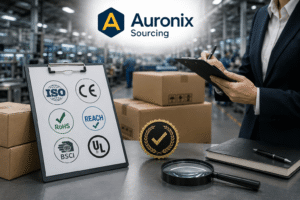
When sourcing products from China or other manufacturing markets, supplier certifications can make a factory appear more trustworthy. Manufacturers frequently display certificates on websites, Alibaba profiles, catalogs, quotations, and factory walls to demonstrate their quality systems, environmental practices, social responsibility, or product compliance.
Certifications can provide valuable information, but they are often misunderstood.
A certificate does not automatically prove that a supplier will produce high-quality products, meet every regulatory requirement, or deliver your order correctly. Importers need to understand exactly what each certification covers, whether it is valid, who issued it, and whether it applies to the factory, product, or process being evaluated.
Used correctly, certifications are an important part of supplier verification. Used incorrectly, they can create false confidence.
Why Supplier Certifications Matter
Certifications generally exist to demonstrate that a company, management system, process, or product has been assessed against defined requirements.
Depending on the industry, buyers may encounter certifications or reports relating to:
- Quality management
- Environmental management
- Occupational health and safety
- Social responsibility
- Information security
- Food safety
- Product safety
- Laboratory testing
- Industry-specific manufacturing requirements
The key is understanding what has actually been certified.
A factory certification and a product certification are not the same thing.
1. ISO 9001 Does Not Mean Every Product Is High Quality
One of the most commonly encountered certifications is ISO 9001, which relates to quality management systems.
Importers sometimes interpret ISO 9001 as proof that every product leaving the factory will be defect-free.
That is not what it means.
ISO 9001 focuses on whether an organization has a structured quality-management system covering areas such as documented processes, responsibilities, continual improvement, and control of operations.
A certified factory can still produce defective products.
The certification provides information about the management system—not a guarantee about the quality of your specific shipment.
2. Management-System Certification Is Different From Product Compliance
This distinction is critical.
A factory might have a recognized quality-management certification while the product itself still requires separate testing, documentation, labeling, or conformity assessment for the destination market.
For example:
Factory Management System ≠ Product Compliance
Your product requirements depend on what the product is, how it is used, and where it will be sold.
Never assume that a supplier’s general factory certification automatically makes every product legally suitable for the USA, UK, EU, Canada, or another market.
3. Check Who the Certificate Belongs To
A supplier may send you a legitimate-looking certificate, but the company name deserves careful attention.
Verify whether the certificate belongs to:
- The company receiving your payment
- The actual manufacturing facility
- A related company
- A subcontractor
- Another factory entirely
Chinese suppliers may operate through different manufacturing and trading entities, so company relationships sometimes require additional investigation.
The certificate should be connected to the entity and facility relevant to your production.
4. Check the Certification Scope
Certificates normally have a defined scope.
A manufacturer may be certified for one category of activity while offering many unrelated products.
For example, the certification scope might cover:
Manufacturing and assembly of specific electronic accessories
while the supplier is quoting a completely different product category.
Read the scope instead of looking only at the certification logo.
Ask:
Does this certification actually cover the operation relevant to my product?
That question can reveal important limitations.
5. Check Whether the Certificate Is Current
Certificates can expire, be suspended, or become outdated.
Do not rely on a PDF simply because it contains an official-looking logo.
Check:
- Issue date
- Expiration date
- Certificate number
- Certified company name
- Facility address
- Scope
- Certification body
Where possible, verify the certificate through the issuing or certification body’s official verification system.
An expired certificate should not be presented as evidence of current certification status.
6. Evaluate the Certification Body
Not every certificate carries the same level of credibility.
Ask who issued it.
The value of third-party certification depends partly on the competence and legitimacy of the organization performing the assessment.
Importers should therefore avoid evaluating certificates based only on appearance.
A professional PDF with stamps and signatures can still require independent verification.
For important sourcing projects, verify the certification body and the certificate itself rather than relying exclusively on documents supplied by the seller.
7. Certifications Can Reveal Factory Maturity
Although certifications do not guarantee product quality, credible management-system certifications can provide useful signals about organizational maturity.
Maintaining a formal system can require factories to establish procedures for areas such as:
Documentation → Responsibilities → Process Control → Corrective Actions → Internal Reviews
This may indicate that the manufacturer has experience working with structured customer requirements.
However, the real question is whether those systems are actively used.
A certificate on the wall has limited value if employees do not follow the underlying procedures.
8. Compare Certification Claims With Factory Reality
During a factory audit or evaluation, compare documentation with actual operations.
Suppose the factory claims strong quality-management controls.
You might investigate whether it actually maintains:
- Incoming material inspection
- Production inspection records
- Defect records
- Corrective-action procedures
- Calibration controls
- Traceability systems
- Final inspection procedures
The objective is to determine whether the documented system exists in everyday manufacturing operations.
Certification should support your supplier assessment—not replace it.
9. Ask for Product-Specific Test Reports
For products requiring safety or performance verification, request documentation relevant to the specific product.
A generic factory certificate may tell you very little about whether a particular SKU meets required standards.
Depending on the product and destination market, documentation may involve laboratory testing or other conformity evidence.
Check whether the report matches:
Product Model + Materials + Components + Applicable Requirements
A report for a similar-looking product is not necessarily evidence for your exact product.
10. Watch for Mismatched Model Numbers
One common documentation problem is receiving a test report for a different product model.
The supplier may say:
“This is almost the same product.”
That may not be sufficient.
Differences in components, materials, electrical specifications, dimensions, or construction can affect whether existing documentation remains applicable.
Compare the model number and technical details carefully.
If there is uncertainty, obtain appropriate professional compliance guidance before importing.
11. Certifications Do Not Replace Factory Audits
A certificate answers specific questions.
A factory audit can answer different ones.
Depending on its scope, an audit may examine:
- Manufacturing capability
- Machinery
- Workforce
- Production processes
- Quality systems
- Warehousing
- Capacity
- Subcontracting
A supplier may hold certifications while still being unsuitable for your particular product or production volume.
Supplier qualification should therefore use multiple forms of evidence.
12. Certifications Do Not Replace Samples
Even a highly certified factory should still provide appropriate samples.
Samples help buyers evaluate:
Appearance + Dimensions + Materials + Function + Packaging + Workmanship
For custom products, several sample iterations may be required before mass production.
The approved sample can then become part of the quality reference alongside detailed specifications.
Certification does not remove the need for product development.
13. Certifications Do Not Replace Inspection
One of the biggest mistakes is assuming a certified supplier does not require pre-shipment inspection.
Management systems reduce certain risks but cannot eliminate production variation.
Problems can still occur because of:
- Incorrect materials
- Assembly mistakes
- Packaging errors
- Cosmetic defects
- Missing accessories
- Unauthorized changes
Pre-shipment inspection provides information about the actual production batch before shipment.
That is fundamentally different from evaluating a factory’s certification status.
14. Be Careful With Certification Logos
Supplier websites often display rows of recognizable logos.
Do not assume every logo means the supplier itself holds a valid certification.
Ask for supporting documentation.
Then verify:
Certificate Number → Company → Facility → Scope → Validity
Similarly, product packaging may display regulatory or certification markings that have specific legal requirements.
A printed logo is not proof of legitimate compliance.
15. Build Certifications Into Your Supplier Approval Process
Certifications are most useful when incorporated into a structured supplier-verification system.
A practical process might include:
Company Verification → Certification Review → Factory Capability → Sample Approval → Product Testing → Quality Requirements → Production Monitoring → Pre-Shipment Inspection
Each stage answers a different question.
Together, they provide a stronger picture of supplier reliability than any single document.
How Auronix Approaches Supplier Certification Verification
Auronix Sourcing treats certifications as one component of supplier due diligence rather than automatic proof of manufacturing reliability.
Depending on the sourcing project, supplier evaluation can include reviewing company information, manufacturing capability, certification documentation, product specifications, samples, testing requirements, production processes, and quality-control performance.
Where certification or compliance is commercially or legally important, the relevant documents should be checked against the actual supplier, product, scope, and applicable market requirements.
The objective is to replace assumptions with verifiable evidence.
Conclusion
Supplier certifications can provide valuable information, but only when importers understand what they actually represent.
A certificate may tell you something about a factory’s:
Management System + Processes + Environmental Practices + Safety Systems + Product or Industry Requirements
But it does not automatically guarantee:
Perfect Quality + Regulatory Compliance + Reliable Delivery + Correct Mass Production
Before relying on a supplier certification, verify the company name, factory location, certificate number, scope, validity period, and issuing body. For product-specific requirements, confirm that the relevant documentation actually applies to the product model and configuration you intend to import.
Most importantly, combine certification review with supplier verification, samples, testing where required, production controls, and pre-shipment inspection.
The strongest sourcing decisions are not based on how many certificates a supplier can send.
They are based on whether the factory can provide credible, relevant, current, and verifiable evidence that its systems and products meet the requirements of your business and target market.
When sourcing products from China or other manufacturing markets, supplier certifications can make a factory appear more trustworthy. Manufacturers frequently display certificates on websites, Alibaba profiles, catalogs, quotations, and factory walls to demonstrate their quality systems, environmental practices, social responsibility, or product compliance.
Certifications can provide valuable information, but they are often misunderstood.
A certificate does not automatically prove that a supplier will produce high-quality products, meet every regulatory requirement, or deliver your order correctly. Importers need to understand exactly what each certification covers, whether it is valid, who issued it, and whether it applies to the factory, product, or process being evaluated.
Used correctly, certifications are an important part of supplier verification. Used incorrectly, they can create false confidence.
Why Supplier Certifications Matter
Certifications generally exist to demonstrate that a company, management system, process, or product has been assessed against defined requirements.
Depending on the industry, buyers may encounter certifications or reports relating to:
- Quality management
- Environmental management
- Occupational health and safety
- Social responsibility
- Information security
- Food safety
- Product safety
- Laboratory testing
- Industry-specific manufacturing requirements
The key is understanding what has actually been certified.
A factory certification and a product certification are not the same thing.
1. ISO 9001 Does Not Mean Every Product Is High Quality
One of the most commonly encountered certifications is ISO 9001, which relates to quality management systems.
Importers sometimes interpret ISO 9001 as proof that every product leaving the factory will be defect-free.
That is not what it means.
ISO 9001 focuses on whether an organization has a structured quality-management system covering areas such as documented processes, responsibilities, continual improvement, and control of operations.
A certified factory can still produce defective products.
The certification provides information about the management system—not a guarantee about the quality of your specific shipment.
2. Management-System Certification Is Different From Product Compliance
This distinction is critical.
A factory might have a recognized quality-management certification while the product itself still requires separate testing, documentation, labeling, or conformity assessment for the destination market.
For example:
Factory Management System ≠ Product Compliance
Your product requirements depend on what the product is, how it is used, and where it will be sold.
Never assume that a supplier’s general factory certification automatically makes every product legally suitable for the USA, UK, EU, Canada, or another market.
3. Check Who the Certificate Belongs To
A supplier may send you a legitimate-looking certificate, but the company name deserves careful attention.
Verify whether the certificate belongs to:
- The company receiving your payment
- The actual manufacturing facility
- A related company
- A subcontractor
- Another factory entirely
Chinese suppliers may operate through different manufacturing and trading entities, so company relationships sometimes require additional investigation.
The certificate should be connected to the entity and facility relevant to your production.
4. Check the Certification Scope
Certificates normally have a defined scope.
A manufacturer may be certified for one category of activity while offering many unrelated products.
For example, the certification scope might cover:
Manufacturing and assembly of specific electronic accessories
while the supplier is quoting a completely different product category.
Read the scope instead of looking only at the certification logo.
Ask:
Does this certification actually cover the operation relevant to my product?
That question can reveal important limitations.
5. Check Whether the Certificate Is Current
Certificates can expire, be suspended, or become outdated.
Do not rely on a PDF simply because it contains an official-looking logo.
Check:
- Issue date
- Expiration date
- Certificate number
- Certified company name
- Facility address
- Scope
- Certification body
Where possible, verify the certificate through the issuing or certification body’s official verification system.
An expired certificate should not be presented as evidence of current certification status.
6. Evaluate the Certification Body
Not every certificate carries the same level of credibility.
Ask who issued it.
The value of third-party certification depends partly on the competence and legitimacy of the organization performing the assessment.
Importers should therefore avoid evaluating certificates based only on appearance.
A professional PDF with stamps and signatures can still require independent verification.
For important sourcing projects, verify the certification body and the certificate itself rather than relying exclusively on documents supplied by the seller.
7. Certifications Can Reveal Factory Maturity
Although certifications do not guarantee product quality, credible management-system certifications can provide useful signals about organizational maturity.
Maintaining a formal system can require factories to establish procedures for areas such as:
Documentation → Responsibilities → Process Control → Corrective Actions → Internal Reviews
This may indicate that the manufacturer has experience working with structured customer requirements.
However, the real question is whether those systems are actively used.
A certificate on the wall has limited value if employees do not follow the underlying procedures.
8. Compare Certification Claims With Factory Reality
During a factory audit or evaluation, compare documentation with actual operations.
Suppose the factory claims strong quality-management controls.
You might investigate whether it actually maintains:
- Incoming material inspection
- Production inspection records
- Defect records
- Corrective-action procedures
- Calibration controls
- Traceability systems
- Final inspection procedures
The objective is to determine whether the documented system exists in everyday manufacturing operations.
Certification should support your supplier assessment—not replace it.
9. Ask for Product-Specific Test Reports
For products requiring safety or performance verification, request documentation relevant to the specific product.
A generic factory certificate may tell you very little about whether a particular SKU meets required standards.
Depending on the product and destination market, documentation may involve laboratory testing or other conformity evidence.
Check whether the report matches:
Product Model + Materials + Components + Applicable Requirements
A report for a similar-looking product is not necessarily evidence for your exact product.
10. Watch for Mismatched Model Numbers
One common documentation problem is receiving a test report for a different product model.
The supplier may say:
“This is almost the same product.”
That may not be sufficient.
Differences in components, materials, electrical specifications, dimensions, or construction can affect whether existing documentation remains applicable.
Compare the model number and technical details carefully.
If there is uncertainty, obtain appropriate professional compliance guidance before importing.
11. Certifications Do Not Replace Factory Audits
A certificate answers specific questions.
A factory audit can answer different ones.
Depending on its scope, an audit may examine:
- Manufacturing capability
- Machinery
- Workforce
- Production processes
- Quality systems
- Warehousing
- Capacity
- Subcontracting
A supplier may hold certifications while still being unsuitable for your particular product or production volume.
Supplier qualification should therefore use multiple forms of evidence.
12. Certifications Do Not Replace Samples
Even a highly certified factory should still provide appropriate samples.
Samples help buyers evaluate:
Appearance + Dimensions + Materials + Function + Packaging + Workmanship
For custom products, several sample iterations may be required before mass production.
The approved sample can then become part of the quality reference alongside detailed specifications.
Certification does not remove the need for product development.
13. Certifications Do Not Replace Inspection
One of the biggest mistakes is assuming a certified supplier does not require pre-shipment inspection.
Management systems reduce certain risks but cannot eliminate production variation.
Problems can still occur because of:
- Incorrect materials
- Assembly mistakes
- Packaging errors
- Cosmetic defects
- Missing accessories
- Unauthorized changes
Pre-shipment inspection provides information about the actual production batch before shipment.
That is fundamentally different from evaluating a factory’s certification status.
14. Be Careful With Certification Logos
Supplier websites often display rows of recognizable logos.
Do not assume every logo means the supplier itself holds a valid certification.
Ask for supporting documentation.
Then verify:
Certificate Number → Company → Facility → Scope → Validity
Similarly, product packaging may display regulatory or certification markings that have specific legal requirements.
A printed logo is not proof of legitimate compliance.
15. Build Certifications Into Your Supplier Approval Process
Certifications are most useful when incorporated into a structured supplier-verification system.
A practical process might include:
Company Verification → Certification Review → Factory Capability → Sample Approval → Product Testing → Quality Requirements → Production Monitoring → Pre-Shipment Inspection
Each stage answers a different question.
Together, they provide a stronger picture of supplier reliability than any single document.
How Auronix Approaches Supplier Certification Verification
Auronix Sourcing treats certifications as one component of supplier due diligence rather than automatic proof of manufacturing reliability.
Depending on the sourcing project, supplier evaluation can include reviewing company information, manufacturing capability, certification documentation, product specifications, samples, testing requirements, production processes, and quality-control performance.
Where certification or compliance is commercially or legally important, the relevant documents should be checked against the actual supplier, product, scope, and applicable market requirements.
The objective is to replace assumptions with verifiable evidence.
Conclusion
Supplier certifications can provide valuable information, but only when importers understand what they actually represent.
A certificate may tell you something about a factory’s:
Management System + Processes + Environmental Practices + Safety Systems + Product or Industry Requirements
But it does not automatically guarantee:
Perfect Quality + Regulatory Compliance + Reliable Delivery + Correct Mass Production
Before relying on a supplier certification, verify the company name, factory location, certificate number, scope, validity period, and issuing body. For product-specific requirements, confirm that the relevant documentation actually applies to the product model and configuration you intend to import.
Most importantly, combine certification review with supplier verification, samples, testing where required, production controls, and pre-shipment inspection.
The strongest sourcing decisions are not based on how many certificates a supplier can send.
They are based on whether the factory can provide credible, relevant, current, and verifiable evidence that its systems and products meet the requirements of your business and target market.