
International shipping does not end when products leave the factory. Between production and final delivery, goods may pass through warehouses, trucks, ports, containers, vessels, customs facilities, distribution centers, and last-mile delivery networks.
At every stage, there is some possibility of damage.
Cartons can be crushed, products can shift inside packaging, moisture can enter containers, pallets can be mishandled, or goods can be affected by impact during transportation. For importers, discovering damaged inventory at the destination can create financial losses, delayed sales, customer complaints, and insurance disputes.
The best approach is to understand what to do immediately after discovering damage—and how to reduce the risk before the shipment ever leaves the factory.
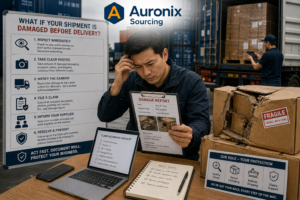
How Does Shipping Damage Happen?
International freight involves repeated movement and handling.
Common causes of shipment damage include:
- Poor retail packaging
- Weak master cartons
- Insufficient cushioning
- Incorrect palletization
- Cargo movement during transit
- Heavy cartons stacked on lighter goods
- Forklift damage
- Water or moisture exposure
- Container condensation
- Rough loading or unloading
- Incorrect cargo securing
Sometimes the transportation provider is responsible. In other situations, the real problem begins with inadequate packaging at the factory.
Determining the cause is important when deciding what happens next.
1. Inspect the Shipment Before Accepting It
When possible, examine the external condition of the shipment when it arrives.
Look for visible signs such as:
- Crushed cartons
- Torn boxes
- Wet packaging
- Broken pallets
- Punctures
- Missing cartons
- Damaged seals
- Severe deformation
If obvious damage exists, document it immediately.
Do not wait several days before taking photographs.
The condition of the cargo at delivery can become important evidence for determining when the damage occurred.
2. Take Detailed Photos and Videos
Documentation is one of the most important steps after discovering damaged cargo.
Take clear photographs of:
Container or Vehicle → Pallets → Master Cartons → Shipping Labels → Damaged Packaging → Damaged Products
Where relevant, photograph the container number, seal, carton markings, and other identifying information.
Video can also be useful when opening visibly damaged cartons.
Do not immediately throw damaged packaging away. It may provide evidence showing how the goods were affected.
3. Record the Damage on Delivery Documents
If visible damage is discovered during delivery, ensure it is documented appropriately with the carrier or delivery provider rather than signing as though everything arrived in perfect condition.
Procedures vary depending on the carrier, freight mode, country, and contract.
The important principle is to create a contemporaneous record.
A written note showing that damage was visible at delivery can be significantly stronger than reporting the issue much later.
4. Separate Damaged and Undamaged Inventory
Do not immediately mix the entire shipment into normal warehouse inventory.
Separate affected cartons where practical.
You may need to classify goods into categories such as:
Undamaged → Packaging Damage Only → Potential Product Damage → Unsellable
This helps determine the actual commercial loss.
A crushed master carton does not necessarily mean every product inside is damaged.
Likewise, a carton that appears normal externally may contain damaged products.
5. Inspect the Products Inside
External inspection is only the first stage.
Open appropriate cartons and evaluate the actual products.
Check for:
- Cracks
- Dents
- Scratches
- Broken components
- Water exposure
- Deformation
- Missing accessories
- Functional failure
For electronic or mechanical products, functional testing may also be necessary.
The objective is to determine the difference between packaging damage and actual product damage.
That distinction can significantly affect the value of a claim.
6. Determine Where the Damage Happened
Next, investigate the likely cause.
Was the product already damaged when it left the factory?
Did the master cartons fail?
Was cargo loaded incorrectly?
Did damage occur during sea freight, customs handling, warehouse operations, or final delivery?
Relevant evidence can include:
- Pre-shipment inspection reports
- Factory loading photographs
- Container loading records
- Packing lists
- Warehouse receiving reports
- Delivery documentation
- Photos at destination
Good documentation throughout the supply chain makes responsibility easier to investigate.
7. Notify the Relevant Parties Quickly
If you believe there may be an insurance or carrier claim, do not delay.
Depending on the shipment, relevant parties could include the freight forwarder, carrier, cargo insurer, supplier, warehouse, or another logistics provider.
Claims procedures and notification deadlines can vary.
Ask immediately:
What is the claim procedure?
What documentation is required?
What deadlines apply?
Do not assume that reporting damage automatically creates a successful claim.
8. Check Your Cargo Insurance
Importers should understand their insurance arrangements before shipping—not after damage occurs.
Cargo insurance can potentially protect against specified transit risks, but coverage depends on the actual policy.
Review details such as:
- Covered risks
- Insured value
- Exclusions
- Deductible
- Required documentation
- Claim procedures
- Notification deadlines
Not every type of damage is automatically covered.
For example, losses caused by inadequate packaging may be treated differently depending on the policy and circumstances.
Review the actual insurance terms rather than assuming that “insured shipment” means every loss will be reimbursed.
9. Preserve Evidence for the Claim
An insurer or carrier may request evidence supporting the loss.
Possible documents include:
- Commercial invoice
- Packing list
- Bill of lading or air waybill
- Insurance certificate or policy
- Delivery receipt
- Photographs
- Inspection report
- Damage report
- Repair or replacement estimates
- Correspondence with relevant parties
Keep records organized.
Avoid disposing of damaged goods or packaging until you understand whether they need to be inspected or retained for the claim.
10. Calculate the Actual Loss
Do not simply report:
“30 cartons are damaged.”
Determine the commercial impact as accurately as possible.
For example:
200 units inspected
35 units have damaged retail packaging
12 units have cosmetic product damage
5 units are non-functional
Different damage levels may have different financial consequences.
Some products might be repackaged, while others may need repair or replacement.
Accurate classification strengthens decision-making and claim documentation.
11. Investigate the Packaging Design
After dealing with the immediate problem, determine whether packaging contributed to the damage.
Ask:
Was the master carton strong enough?
Was there too much empty space?
Did products move inside the box?
Was cushioning adequate?
Were heavy cartons stacked incorrectly?
Was moisture protection sufficient?
If packaging failed under reasonably foreseeable transportation conditions, redesigning it may prevent the same loss on future orders.
12. Consider Packaging Testing Before Future Shipments
For products with meaningful transportation risk, packaging can be tested before mass shipment.
Depending on the product and distribution environment, this may involve appropriate:
- Drop testing
- Compression testing
- Vibration testing
- Packaging integrity checks
- Environmental testing
The correct testing method should reflect the product and actual logistics environment.
A successful product design combined with weak packaging still creates a vulnerable shipment.
13. Improve Container Loading
For larger shipments, loading quality matters.
Cartons should be arranged appropriately to reduce movement and crushing risk.
Depending on the cargo, loading considerations can include weight distribution, stacking configuration, pallet condition, void spaces, securing methods, and moisture management.
Container loading supervision or documentation can provide valuable evidence of the shipment’s condition before departure.
This can also help identify problems before the container is sealed.
14. Don’t Automatically Blame the Factory
When damaged inventory arrives, the factory is often the first party the buyer contacts.
But responsibility should be based on evidence.
If the supplier used the agreed packaging and goods were confirmed in acceptable condition before loading, damage may have occurred later.
Conversely, if packaging was clearly inadequate or products were already defective before shipment, the factory may be involved.
A structured investigation is more useful than immediately assigning blame.
15. Prevent Damage Before Shipment
The most effective strategy starts before goods leave China.
Consider a workflow such as:
Packaging Specification → Sample Approval → Production → Pre-Shipment Inspection → Packaging Verification → Loading Documentation → Cargo Insurance → Shipment
Each stage creates another opportunity to identify risk.
For example, an inspection may discover weak cartons before thousands of units begin their international journey.
Correcting the cartons at the factory is usually easier than handling damaged inventory at the destination.
How Auronix Helps Reduce Shipping Risk
Auronix Sourcing approaches shipping risk as part of the wider sourcing process.
Depending on the project, this can include supplier coordination, packaging verification, quality inspection, production monitoring, shipment preparation, and freight coordination.
The objective is to identify avoidable risks before goods leave the supplier and maintain clearer documentation throughout the shipment process.
When damage does occur, good records from production, inspection, packing, and loading can make it easier to investigate where the problem originated.
Conclusion
If your shipment is damaged before delivery, speed and documentation matter.
Start by recording the condition of the cargo. Photograph damaged cartons and products, preserve relevant packaging, separate affected inventory, document issues with the appropriate delivery party, and notify relevant logistics or insurance providers quickly.
Then determine:
What was damaged? → How much was damaged? → When did the damage likely occur? → Who needs to be notified? → Is the loss covered?
After resolving the immediate issue, investigate the root cause.
If packaging was too weak, improve it. If cargo moved during transportation, review loading and securing. If moisture caused damage, evaluate environmental protection. If logistics handling was responsible, review the shipping arrangement.
The goal is not merely to recover money after a damaged shipment.
A stronger sourcing strategy is designed to prevent avoidable damage before the products begin their journey—and maintain enough evidence to respond effectively when something still goes wrong.