
Switching factories is one of the most important decisions an importer can make.
Changing too quickly can create unnecessary costs, new quality risks, tooling complications, sampling delays, and production disruption. Waiting too long can be equally damaging if the existing supplier is experiencing worsening quality, repeated delays, uncontrolled price increases, or declining communication.
The problem is that supplier relationships often become influenced by habit.
A buyer may continue working with the same factory because:
“We have used them for years.”
That is not necessarily evidence that the supplier is still the best choice.
Professional importers use supplier performance data to determine whether a factory should be improved, monitored, supplemented with a backup supplier, or replaced.
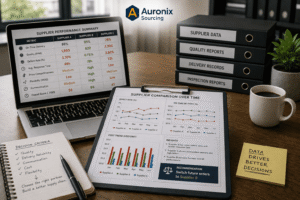
Do Not Switch Because of One Problem
Even excellent manufacturers occasionally experience problems.
A machine can fail.
A material shipment can arrive late.
A production batch can require rework.
One isolated incident does not necessarily justify moving production.
Instead, ask:
- How serious was the problem?
- Did the supplier report it early?
- Was the root cause identified?
- Was corrective action implemented?
- Did the problem happen again?
The supplier’s response can sometimes reveal more than the original failure.
Look for Performance Trends
Individual events tell you what happened.
Trends tell you what is changing.
Consider a supplier whose observed defect rates across five comparable inspections are:
1.0% → 1.3% → 1.9% → 2.6% → 3.2%
The important issue is not simply that the latest inspection found 3.2%.
The trend suggests quality performance may be deteriorating.
That should trigger investigation.
Track Quality Over Multiple Orders
Quality data should be maintained by purchase order.
Useful indicators can include:
- Defect rates
- Inspection results
- Reinspection frequency
- Rework
- Customer complaints
- Manufacturing-related returns
- Repeat defects
The exact metrics should reflect the product and inspection methodology.
Consistency matters because changing measurement methods can distort comparisons.
Watch Repeat Defects Closely
A new defect can occur for many reasons.
A repeated defect after corrective action is more concerning.
Suppose:
PO-01: Surface scratching discovered.
The factory implements corrective action.
PO-02: Surface scratching returns.
Another corrective action is promised.
PO-03: Same defect appears again.
At this point, the issue may indicate weak root-cause analysis or poor process control.
Repeat defects deserve significant weight in supplier decisions.
Track Inspection Failure Frequency
One failed inspection does not automatically make a factory unacceptable.
Repeated failures are different.
Record:
Inspections Conducted → Inspections Passed → Reinspections Required
A supplier that repeatedly requires rework and reinspection may be generating hidden costs even when the final goods eventually ship.
Measure Delivery Reliability
Late production can create:
- Stockouts
- Missed launches
- Emergency freight
- Customer dissatisfaction
Track whether the factory meets the agreed:
- Production completion date
- Inspection-ready date
- Cargo-ready date
Use one consistent definition.
If delivery reliability declines across several orders, investigate whether the supplier has a temporary problem or a structural capacity issue.
Measure the Severity of Delays
On-time percentage alone is not enough.
Consider two suppliers.
Supplier A: Two late orders, each delayed two days.
Supplier B: Two late orders, delayed 14 and 21 days.
Their on-time percentage could be identical.
Their operational impact is not.
Track:
Delay Frequency + Average Delay + Maximum Delay
This gives a much more realistic picture.
Monitor Lead-Time Creep
Lead times can deteriorate gradually.
For example:
| Order | Promised | Actual |
|---|---|---|
| PO-01 | 30 days | 31 days |
| PO-02 | 30 days | 34 days |
| PO-03 | 30 days | 39 days |
| PO-04 | 30 days | 44 days |
If the supplier continues quoting 30 days while actual performance moves toward 45, planning becomes unreliable.
The problem is not simply longer lead time.
It is the gap between promise and reality.
Track Production Milestones
Final delivery data may reveal problems too late.
Monitor intermediate milestones such as:
Materials Ready → Production Start → Assembly → Packaging → Inspection Ready
This can reveal where delays repeatedly originate.
If material preparation is late on five consecutive orders, the supplier may have a purchasing or upstream supplier problem.
Monitor Unauthorized Changes
Unauthorized substitutions should receive serious attention.
Examples include changes to:
- Materials
- Components
- Dimensions
- Colors
- Packaging
- Manufacturing processes
A factory should not silently change critical approved specifications simply because another option is cheaper or easier to obtain.
Repeated unauthorized changes can indicate a fundamental breakdown in supplier control.
Measure Cost Performance
Switching decisions should not be driven only by unit price.
Track:
- Unit cost
- Tooling charges
- Packaging costs
- Sample charges
- Rework costs
- Reinspection costs
- Replacement costs
This provides a more complete picture of supplier economics.
Calculate the Cost of Poor Quality
Imagine Supplier A charges:
$4.80 per unit
Supplier B charges:
$5.00 per unit
Supplier A appears cheaper.
But Supplier A also creates recurring costs from:
- Reinspection
- Sorting
- Rework
- Returns
- Replacement inventory
- Emergency shipping
Once these costs are included, Supplier B may actually provide better overall value.
Factory-switching decisions should therefore consider total supplier cost, not quotation price alone.
Monitor Price Increases
Price increases are not automatically evidence that a supplier should be replaced.
Costs can legitimately change because of:
- Raw materials
- Components
- Labor
- Packaging
- Currency movements
However, repeated unexplained increases deserve investigation.
Compare the supplier’s pricing with:
- Historical quotations
- Current order quantities
- Specification changes
- Alternative qualified factories
This helps determine whether pricing remains commercially competitive.
Track Communication Accuracy
Supplier communication should be measured by more than response speed.
Ask:
- Are production updates accurate?
- Are problems disclosed early?
- Are technical questions answered properly?
- Are promised actions completed?
A supplier that responds immediately but provides unreliable information can create greater operational risk than one that takes longer to provide accurate answers.
Measure Problem Transparency
Strong suppliers usually communicate problems before they become emergencies.
For example:
“Material delivery is expected three days late. We have developed two recovery options.”
A weak supplier may continue saying:
“Everything is fine.”
until the agreed completion date is missed.
Repeated late disclosure should negatively affect supplier evaluation.
Evaluate Corrective-Action Effectiveness
When problems occur, track the full corrective-action cycle:
Problem → Root Cause → Corrective Action → Verification → Recurrence
Do not simply record that the supplier “fixed” the issue.
Check whether the defect actually disappears from future production.
A supplier that learns from mistakes may still be worth developing.
A supplier repeating the same problems may not be.
Monitor Capacity Problems
Your supplier may have been perfect when you ordered 2,000 units per month.
The same factory may struggle when you require 20,000.
Watch for:
- Production delays
- Increased outsourcing
- Quality deterioration
- Longer lead times
- Difficulty reserving production slots
Sometimes the supplier has not become worse.
Your business has simply outgrown its capabilities.
That is still a valid reason to consider alternatives.
Compare Performance Against Backup Suppliers
You cannot know whether your existing supplier remains competitive without market comparison.
Periodically benchmark qualified alternatives.
Compare:
| Metric | Current Factory | Alternative |
|---|---|---|
| Quality | 82/100 | 93/100 |
| Delivery | 76/100 | 91/100 |
| Cost | 90/100 | 85/100 |
| Communication | 78/100 | 92/100 |
| Capacity | 72/100 | 94/100 |
The current factory may remain slightly cheaper while the alternative performs substantially better elsewhere.
This creates a more informed switching decision.
Build a Supplier Performance Score
A weighted scorecard can combine several metrics.
For example:
| Category | Weight |
|---|---|
| Quality | 35% |
| Delivery | 25% |
| Cost Performance | 15% |
| Communication | 10% |
| Corrective Action | 10% |
| Capacity | 5% |
| Total | 100% |
Weights should reflect your product and business risks.
The objective is not mathematical perfection.
It is consistent decision-making.
Use Performance Zones
A simple supplier-management framework can classify suppliers as:
Green — Maintain
Performance meets expectations.
Yellow — Improvement Required
Negative trends exist and require corrective action.
Orange — Develop Backup
Multiple important metrics are deteriorating.
Red — Replacement Review
Serious or repeated problems make continued dependence increasingly risky.
Thresholds should be customized rather than copied universally.
Identify Leading Indicators
Do not wait for catastrophic failure.
Some supplier metrics provide early warning.
For example:
Communication Accuracy ↓
may be followed by:
Production Milestone Reliability ↓
which may eventually become:
Delivery Performance ↓
Similarly:
Repeat Defects ↑
may later become:
Inspection Failures ↑ → Customer Complaints ↑
Tracking early indicators gives businesses more time to respond.
Distinguish Temporary Problems From Structural Problems
Before switching, determine whether the supplier’s problem is temporary.
Temporary problems might include:
- Short-term machine failure
- One unusual material delay
- Temporary labor shortage
Structural problems may include:
- Insufficient capacity
- Weak quality systems
- Chronic subcontractor dependence
- Repeated unauthorized substitutions
- Persistent management problems
Structural problems are much harder to correct.
Give Strong Suppliers a Corrective Opportunity
If a supplier has years of strong historical performance, an immediate switch after a short-term decline may be unnecessary.
Present the performance data.
Define required improvements.
Set a review period.
For example:
Problem: On-time performance dropped from 95% to 72%.
Target: Restore agreed delivery performance.
Actions: Earlier material purchasing and weekly milestone reporting.
Then monitor subsequent orders.
If performance recovers, switching may not be necessary.
Know When Improvement Is Not Working
Corrective plans should have measurable results.
If the supplier repeatedly promises improvement but the data continues to show:
Defects ↑
Delays ↑
Rework ↑
Communication Accuracy ↓
then continuing indefinitely may expose the business to unnecessary risk.
At some point, the question changes from:
“Can this supplier improve?”
to:
“Why are we still depending on this supplier?”
Do Not Wait Until You Need a New Factory
Finding and qualifying a replacement manufacturer takes time.
The process may involve:
Supplier Search → Verification → RFQ → Samples → Testing → Audit → Trial Order → Production
Waiting until the existing factory completely fails creates enormous pressure.
Develop backup suppliers while the primary factory is still operational.
Calculate Switching Costs
Moving factories is not free.
Potential costs include:
- New samples
- New tooling
- Engineering work
- Factory audits
- Trial production
- Packaging changes
- Quality validation
There may also be learning-curve risk with the new manufacturer.
Compare these costs against the expected cost of staying with the current supplier.
Protect Tooling and Product Information
Before switching, review control over:
- Molds
- Tooling
- Drawings
- Artwork
- Product specifications
- Approved samples
Contractual and intellectual-property considerations should be reviewed appropriately.
Do not assume tooling can automatically be transferred between factories.
Consider Dual Sourcing Before Full Replacement
Switching does not always need to happen overnight.
For suitable products, businesses may gradually move volume.
For example:
Current Factory: 70%
New Factory: 30%
If the new factory proves reliable, allocation can change over time.
This reduces transition risk and provides real production data before complete dependence on the new supplier.
Use Trial Orders
Before transferring major volume, test the new supplier with an appropriate production order.
Evaluate:
- Quality
- Lead time
- Packaging
- Communication
- Inspection results
A perfect sample does not guarantee perfect mass production.
Trial orders provide much stronger evidence.
Compare Both Factories Using the Same Data
During transition, evaluate the existing and new supplier using the same scorecard.
Do not automatically assume the new factory is better simply because you are frustrated with the current supplier.
Use comparable evidence.
The replacement should represent a genuine improvement.
Maintain Historical Supplier Records
Keep records of:
- Purchase orders
- Inspection reports
- Defect rates
- Delays
- Pricing
- Corrective actions
- Supplier scores
Historical data provides institutional memory.
If employees change, the company still understands why supplier decisions were made.
How Auronix Sourcing Supports Supplier Transition Decisions
Auronix Sourcing helps businesses evaluate whether existing Chinese manufacturers remain suitable and identify qualified alternatives when performance begins to deteriorate.
Support can include supplier-performance analysis, defect tracking, quality inspection, corrective-action follow-up, factory audits and visits, pricing comparisons, production-capacity evaluation, alternative supplier sourcing, supplier verification, sample management, trial orders, production monitoring, packaging coordination, shipment consolidation, and international shipping coordination.
By comparing existing supplier performance with verified alternatives, Auronix helps businesses make factory-switching decisions based on operational evidence rather than frustration or price alone.
Conclusion
The right time to consider switching factories is not simply when one order goes wrong.
It is when the data begins showing a pattern that the supplier can no longer reliably meet your business requirements.
Watch for combinations such as:
Quality ↓ + Delays ↑ + Repeat Defects ↑ + Costs ↑ + Transparency ↓
Then investigate the root causes, require measurable corrective action, and compare the supplier against qualified alternatives.
A disciplined decision process looks like:
Track Performance → Identify Trend → Investigate Cause → Correct → Measure Again → Qualify Backup → Compare → Transition if Necessary
Sometimes the data will show that the existing supplier deserves another opportunity.
Sometimes it will show that your business has outgrown the factory.
And sometimes it will confirm that switching is overdue.
With Auronix Sourcing, businesses can monitor supplier performance, inspect production, manage corrective actions, verify alternative factories, run trial orders, and coordinate supplier transitions—helping ensure that changing manufacturers becomes a controlled sourcing decision rather than an emergency reaction.