
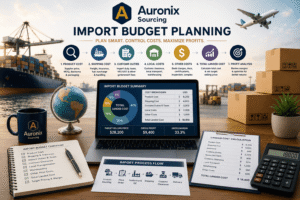
Import budget planning is one of the most important steps in building a profitable international sourcing business. Many new importers focus primarily on the supplier’s unit price, but the actual cost of importing products includes manufacturing, quality control, packaging, freight, customs, warehousing, and several other expenses.
Without a realistic budget, a product that appears profitable at the factory quotation stage can become significantly less attractive after all import costs are included.
A well-planned import budget helps businesses understand their total investment, protect cash flow, calculate accurate product margins, and prepare for unexpected expenses.
This guide explains how businesses can create a practical import budget before placing an international order.
Start With the Product Cost
The first component of an import budget is the amount paid to the supplier.
Product cost generally depends on:
- Unit price
- Order quantity
- Product specifications
- Materials
- Customization
- Manufacturing processes
- Minimum order quantity
- Supplier pricing structure
Importers should obtain detailed quotations from multiple qualified suppliers whenever practical.
However, the cheapest quotation should not automatically determine supplier selection. Manufacturing capability, quality, production capacity, communication, and reliability should also be evaluated.
Include Product Development Costs
Businesses developing OEM, ODM, or private-label products may have additional expenses before mass production begins.
These can include:
- Product design
- Prototypes
- Sample development
- Mold or tooling charges
- Custom colors
- Logo application
- Packaging design
- Product testing
Some expenses may be one-time investments, while others apply to every production order.
Understanding these costs early helps businesses determine the amount of capital required before launching a product.
Budget for Samples
Sample approval is an important part of international sourcing and should have its own budget.
The cost may include the sample itself, customization, international courier charges, and multiple revisions.
Businesses should avoid skipping samples simply to save money.
An approved sample provides an opportunity to verify materials, dimensions, functionality, appearance, workmanship, branding, and packaging before committing to mass production.
Sample expenses are generally small compared with the potential cost of receiving an entire order that does not meet expectations.
Calculate Packaging Costs
Packaging can represent a meaningful part of total product cost, especially for private-label brands.
Budget for:
- Retail packaging
- Printed boxes
- Inserts
- Labels
- Barcodes
- Protective materials
- Master cartons
- Customized shipping marks
Packaging should also be optimized for international transportation.
Oversized cartons can increase freight costs, while inadequate packaging can result in damaged products.
Packaging verification before shipment helps confirm that the final order matches approved requirements.
Include Supplier Verification and Factory Audits
Supplier verification is a risk-management expense that should be considered when planning larger or strategically important orders.
Depending on the situation, businesses may conduct business verification, factory audits, or physical factory visits.
A factory audit can help assess manufacturing equipment, production capacity, quality systems, working processes, and other relevant operational factors.
Spending money on verification before placing a significant order can reduce the risk of making a much more expensive sourcing mistake.
Budget for Quality Inspection
Quality inspection should not be treated as an optional expense when product consistency is important.
Inspection costs may include pre-production checks, during-production inspections, or pre-shipment inspections.
A pre-shipment inspection can verify product quantity, dimensions, workmanship, functionality, appearance, packaging, labeling, and other agreed specifications.
If defects are identified before shipment, businesses may have an opportunity to request corrective action while the goods are still at the factory.
Discovering the same problems after international delivery can be significantly more expensive.
Calculate Inland Transportation
Products usually need to travel from the supplier’s factory to a warehouse, consolidation center, airport, rail terminal, or seaport.
These domestic transportation expenses should be included in the import budget.
Costs depend on factory location, cargo volume, transportation method, and the agreed Incoterm.
Importers should understand terms such as EXW, FOB, and DDP because each arrangement assigns different responsibilities and costs to the buyer and seller.
Estimate International Freight
International transportation can represent a substantial portion of total landed cost.
Common options include:
Sea Freight
Often suitable for larger shipments where longer transit times are acceptable.
Air Freight
Typically used for faster transportation, smaller shipments, or higher-value products.
Express Courier
Frequently used for samples and smaller parcels.
Sea shipments may also use LCL or FCL depending on cargo volume.
Businesses should obtain current freight estimates when planning orders because transportation costs can change over time.
Plan for Customs Duties and Taxes
Customs duties and taxes vary according to the destination country, product classification, declared customs value, and applicable regulations.
Importers should research their product’s correct customs classification and understand potential import charges before finalizing an order.
Depending on the market, the budget may also need to account for customs brokerage, documentation, inspections, port charges, and other clearance expenses.
Because import regulations vary by country, businesses should verify requirements with relevant authorities or qualified customs professionals when necessary.
Include Warehousing and Final Delivery
The import process does not necessarily end when products clear customs.
Additional costs may include:
- Port-to-warehouse transportation
- Warehouse receiving
- Palletization
- Storage
- Inventory handling
- Fulfillment preparation
- Delivery to distribution centers
Ecommerce businesses may also have marketplace or third-party fulfillment preparation requirements.
These costs should be included when calculating the true landed cost per unit.
Maintain a Contingency Budget
International sourcing can involve unexpected expenses.
Production adjustments, inspection failures, freight changes, customs delays, storage charges, or packaging corrections may create additional costs.
Maintaining a reasonable contingency reserve can prevent unexpected expenses from disrupting cash flow.
The appropriate amount depends on the product, supplier, shipment size, destination, and overall supply chain complexity.
Protect Working Capital
Importing requires businesses to spend money well before products are sold.
A typical cash cycle may involve a production deposit, final supplier payment, inspection costs, freight charges, customs expenses, and warehousing costs before sales revenue is generated.
Businesses should therefore consider both profitability and cash flow when planning orders.
Purchasing excessive quantities to obtain a lower unit price can create financial pressure if inventory sells slowly.
Inventory planning should be aligned with realistic demand forecasts and supplier lead times.
Calculate Total Landed Cost
The final objective of import budget planning is determining the realistic landed cost of each product.
Instead of using only the factory price, combine relevant expenses across sourcing, manufacturing, quality control, packaging, transportation, customs, and delivery.
Once landed cost is understood, businesses can calculate pricing and profit margins more accurately.
This also makes it easier to compare suppliers and identify areas where costs can be optimized.
Common Import Budgeting Mistakes
Common mistakes include budgeting only for product and freight costs, ignoring duties and taxes, skipping inspection expenses, underestimating packaging, and failing to account for warehousing.
Another mistake is using outdated freight quotations or assuming every production order will proceed without unexpected expenses.
Import budgets should be reviewed whenever major costs, order quantities, suppliers, or shipping arrangements change.
How Auronix Sourcing Can Support Import Cost Planning
Accurate budgeting becomes easier when businesses have greater visibility across the sourcing process.
Auronix Sourcing supports businesses sourcing from China with supplier sourcing and verification, factory audits, sample management, production monitoring, quality inspection, packaging verification, consolidation, and international shipping coordination.
Managing these stages systematically can help businesses identify potential expenses earlier and make better purchasing decisions before committing significant capital.
Conclusion
Successful import budget planning requires businesses to look beyond the supplier’s unit price.
Product development, samples, quality inspection, packaging, inland transportation, international freight, customs charges, warehousing, inventory, and contingency expenses can all influence the final cost.
By calculating total landed cost before placing an order, maintaining sufficient working capital, and preparing for unexpected expenses, importers can make more informed sourcing decisions and build a stronger financial foundation for long-term growth.