
Selecting a reliable supplier is important, but supplier evaluation should not stop after the first successful order. Factory performance can change as order volumes increase, employees change, production capacity becomes tighter, raw-material suppliers change, or the manufacturer begins serving more customers.
A supplier that performed extremely well six months ago may not deliver the same results today.
For importers sourcing from China, measuring supplier performance over time provides the data needed to identify declining quality, recurring delays, communication problems, and increasing costs before they become major supply-chain issues.
The objective is not to monitor every possible number. It is to establish a small set of consistent supplier KPIs and track how they change from one production order to the next.
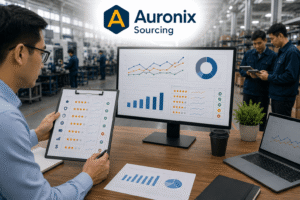
Why Long-Term Supplier Measurement Matters
A single order provides only a snapshot of supplier performance.
Imagine a factory passes one inspection with excellent results. That is encouraging, but it does not prove the factory can consistently maintain the same standard across ten future production runs.
Long-term measurement answers a more important question:
Can this supplier repeatedly deliver the required quality, quantity, cost, and schedule as our business grows?
Tracking performance also makes supplier discussions more objective. Instead of saying, “Your quality seems worse lately,” you can show exactly how performance has changed.
Establish a Supplier Performance Baseline
Start by recording performance during the first few orders.
This creates a baseline against which future results can be compared.
For example:
| Metric | Baseline |
|---|---|
| First-Pass Inspection Rate | 95% |
| On-Time Completion | 92% |
| Quality-Related Complaints | 1.5% |
| Average Production Lead Time | 32 days |
| Corrective Action Closure | 7 days |
The exact metrics should reflect your product and sourcing priorities.
Once the baseline exists, changes become much easier to identify.
1. Track Product Quality
Quality should usually receive significant weight in supplier performance evaluation.
Monitor factors such as:
- Inspection results
- Defect rates
- Rework requirements
- Functional failures
- Packaging defects
- Customer complaints
- Product returns
Do not evaluate only whether an order eventually passed inspection.
A supplier that repeatedly fails initial inspections and performs rework before shipment creates additional management effort and potential delays.
Track first-pass quality as well.
2. Monitor Defect Trends
A defect percentage becomes more valuable when compared across multiple production runs.
Consider:
Order 1: 1.1% defects
Order 2: 1.5% defects
Order 3: 2.8% defects
Order 4: 4.2% defects
Each individual order may initially appear manageable, but the trend shows deterioration.
Investigate before the problem becomes more serious.
Also classify defects by type. Repeated failures in the same component may indicate a specific material, design, assembly, or process weakness.
3. Measure On-Time Performance
Production reliability directly affects inventory planning.
For every purchase order, record:
Agreed Completion Date → Actual Completion Date
Then calculate the supplier’s on-time completion rate.
If 18 out of 20 orders were completed according to the agreed definition of “on time,” the rate would be:
18 ÷ 20 × 100 = 90%
Define clearly whether completion means production finished, inspection-ready, or dispatched from the factory.
Consistency is essential if you want meaningful data.
4. Compare Promised and Actual Lead Times
Do not measure only whether an order was technically late.
Track the difference between promised and actual lead time.
For example:
| Order | Promised | Actual |
|---|---|---|
| PO-01 | 30 days | 31 days |
| PO-02 | 30 days | 34 days |
| PO-03 | 30 days | 39 days |
This reveals whether lead-time reliability is deteriorating.
Predictable lead times make purchasing and inventory forecasting significantly easier.
5. Measure Communication Performance
Communication can be difficult to convert into numbers, but it should still be evaluated.
Consider whether the supplier:
- Provides production updates
- Answers technical questions accurately
- Reports problems early
- Confirms specification changes
- Provides requested documents
- Responds within reasonable timeframes
The most important factor is not necessarily response speed.
Transparency matters more.
A supplier that immediately informs you about a five-day production problem gives you time to respond. A supplier that hides the same delay until the shipping date creates a much larger problem.
6. Track Corrective Action
Manufacturing problems occasionally occur even with good suppliers.
Measure how effectively the factory resolves them.
Record:
Problem Identified → Root Cause → Corrective Action → Completion Date → Verification
Then monitor whether the same defect returns.
A supplier that repeatedly “fixes” the same problem without preventing recurrence has a weak corrective-action system.
Long-term supplier performance should therefore measure both problem resolution and problem recurrence.
7. Monitor Unauthorized Changes
Track any situation where the supplier changes materials, components, packaging, subcontractors, or other important specifications without required approval.
Repeated substitutions can indicate weak internal change control.
For custom and private-label products, this metric can be particularly important.
Even a component that looks identical may have different durability or performance characteristics.
Significant manufacturing changes should follow an agreed approval process.
8. Track Customer Complaints by Production Batch
Factory inspections tell you how products looked and performed before shipment.
Customers tell you what happened during real-world use.
Where practical, connect customer complaints with production batches.
Track recurring issues such as:
- Component failures
- Breakage
- Poor durability
- Missing accessories
- Packaging damage
- Functional problems
If complaints suddenly increase after a particular production run, investigate what changed.
Customer data creates a valuable feedback loop between your market and the factory.
9. Monitor Pricing Over Time
Supplier performance is also commercial.
Track historical unit prices and significant cost changes.
For example:
Order 1: $5.10
Order 2: $5.15
Order 3: $5.35
Order 4: $5.70
Price increases are not automatically unreasonable. Raw materials, labor, exchange rates, components, and packaging can change.
The important question is whether changes are transparent and commercially justified.
Long-term price data also gives importers better information during negotiations.
10. Measure Total Supplier Cost
Unit price should not be evaluated independently from supplier performance.
Calculate costs created by supplier problems, including:
Factory Price + Rework + Extra Inspection + Replacement Goods + Emergency Freight + Returns + Quality Claims
A factory charging $0.25 less per unit may actually be more expensive if it repeatedly creates defects and delays.
This is why sophisticated supplier management focuses on total cost, not simply purchase price.
11. Create a Quarterly Supplier Scorecard
For active suppliers, summarize performance periodically.
A scorecard might include:
| Category | Weight |
|---|---|
| Quality | 30% |
| Delivery Performance | 20% |
| Production Consistency | 15% |
| Corrective Action | 10% |
| Communication | 10% |
| Cost Performance | 10% |
| Documentation | 5% |
Assign each category a consistent score and calculate the weighted total.
For example:
90–100: Excellent
80–89: Strong
70–79: Improvement Required
Below 70: Supplier Review Required
The exact thresholds should reflect your own business requirements.
12. Compare Suppliers Against Each Other
Performance measurement becomes even more valuable when you work with multiple factories.
Suppose Supplier A is slightly cheaper but averages 78/100 while Supplier B averages 91/100.
That difference may justify shifting additional production toward Supplier B.
Supplier comparison can also strengthen negotiations because decisions are based on actual performance rather than impressions.
13. Hold Regular Supplier Reviews
Do not collect performance data without discussing it.
Periodically review results with important suppliers.
Show:
What Improved → What Declined → What Needs Correction → What Target Comes Next
Keep the discussion evidence-based.
For example, instead of saying:
“Your deliveries are always late,”
say:
“Four of the last six production orders missed the agreed completion date, with an average delay of eight days.”
Specific data makes corrective discussions more productive.
14. Reward Strong Suppliers
Supplier performance systems should not only identify poor factories.
They should also identify your strongest manufacturing partners.
High-performing suppliers may deserve:
- Larger order allocations
- Longer-term forecasts
- Earlier production planning
- New product opportunities
- More strategic collaboration
Providing realistic forecasts can also help strong factories reserve capacity and plan materials more effectively.
A supplier should understand that consistently good performance can lead to greater business opportunities.
15. Know When Performance Requires a Backup Supplier
Watch for sustained negative trends.
For example:
Quality ↓ + Delivery Reliability ↓ + Communication ↓ + Costs ↑
One poor order may not justify changing factories.
Several declining metrics across multiple production cycles deserve attention.
At that stage, strengthening a backup supplier becomes sensible even if you continue working with the existing manufacturer.
The objective is to reduce supply-chain dependency before performance becomes critical.
How Auronix Approaches Supplier Performance Management
Auronix Sourcing approaches supplier management as an ongoing process rather than a one-time factory search.
Depending on the project, this can include supplier verification, sample management, production monitoring, quality inspection, packaging verification, corrective-action follow-up, and supplier performance evaluation.
By comparing actual production results over multiple orders, importers can identify trends that may not be visible from a single inspection or quotation.
The objective is to develop suppliers that consistently deliver the required combination of quality, reliability, communication, cost control, and scalability.
Conclusion
Supplier performance should be measured across months and multiple production cycles—not judged from one successful sample or one low quotation.
Track the metrics that directly affect your business:
Quality → Defects → First-Pass Inspection → Delivery → Lead-Time Accuracy → Customer Complaints → Corrective Action → Communication → Cost
Establish a baseline, use the same definitions for every order, and review trends regularly.
When performance declines, investigate early. When suppliers improve, recognize it. When problems repeatedly return despite corrective actions, reduce your dependency and evaluate alternatives.
The purpose of supplier performance measurement is not simply to create another spreadsheet.
It is to turn sourcing decisions into measurable, evidence-based business decisions—so you know which suppliers are improving, which are declining, and which are capable of supporting your business as it grows.