
When sourcing products from a factory, one of the biggest causes of production problems is unclear communication.
A buyer may have a clear idea of what they want, but the factory can only manufacture according to the information it receives. If important details are missing, suppliers may make assumptions based on their own standards, materials, or previous production experience.
This is why a detailed product specification sheet is essential.
A factory-proof product specification sheet clearly explains exactly what needs to be manufactured, how it should look, what materials should be used, and what quality standards must be followed.
For importers sourcing from China, a strong specification sheet can reduce misunderstandings, quotation differences, production errors, and quality disputes.
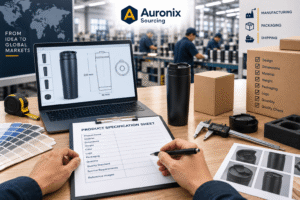
What Is a Product Specification Sheet?
A product specification sheet is a document that defines the technical and visual requirements of a product.
It acts as a reference point between the buyer and supplier throughout sourcing, sampling, production, and quality inspection.
Depending on the product, it may include:
- Product dimensions
- Materials
- Colors
- Thickness
- Weight
- Components
- Branding
- Packaging
- Performance requirements
- Quality standards
- Tolerances
The more clearly these details are defined, the easier it becomes for a supplier to understand the buyer’s expectations.
1. Start With Basic Product Information
Every specification sheet should begin with clear product identification.
Include information such as:
Product Name: Stainless Steel Water Bottle
Model Number: WB-001
Product Version: V2
Intended Market: United States
Order Quantity: 5,000 units
Using model numbers and versions is especially important when a buyer is developing multiple variations of the same product.
It prevents factories from accidentally using an outdated specification.
2. Define Exact Product Dimensions
Never rely on descriptions such as “medium size” or “approximately 30 cm.”
Use exact measurements.
For example:
Height: 300 mm
Width: 120 mm
Depth: 80 mm
Important component dimensions should also be included.
Depending on the product, this may involve:
- Diameter
- Thickness
- Handle length
- Hole position
- Distance between components
- Opening size
- Internal dimensions
Technical drawings can make dimensional requirements much easier for factories to understand.
3. Specify the Material Clearly
Writing only “plastic,” “metal,” or “fabric” may not provide enough information.
Different material grades can produce very different performance and pricing.
Instead, define the material as precisely as possible.
For example:
Material: ABS Plastic
or
Material: Stainless Steel 304
For textiles, buyers may specify:
Fabric: 100% Polyester
Fabric Weight: 220 GSM
Specific material requirements help ensure suppliers are quoting the same product standard.
4. Include Material Thickness or Weight
Material thickness can significantly influence product strength, durability, cost, and weight.
If thickness is important, it should be clearly written in the specification.
For example:
Steel Thickness: 1.2 mm
For products where total weight matters, buyers can also specify a target weight.
Net Product Weight: 850 g ± agreed tolerance
This can help identify changes in material usage during bulk production.
5. Define Colors Properly
Simply writing “blue,” “red,” or “green” can create problems.
Factories may interpret colors differently.
Whenever possible, use recognized color references such as Pantone codes.
For example:
Body Color: Pantone 186 C
If exact Pantone matching is not possible, an approved physical sample can also serve as the color reference.
The goal is to remove as much interpretation as possible.
6. Explain Branding Requirements
If the product includes branding, provide exact details.
This may include:
- Logo size
- Logo position
- Printing method
- Embroidery method
- Engraving
- Label design
- Packaging branding
Instead of writing:
“Put logo on the front.”
A stronger specification would state:
Logo Position: Center front
Logo Width: 40 mm
Printing Method: Screen Printing
Logo Color: White
Artwork files should also be supplied in appropriate production formats.
7. Define Product Construction
For products containing multiple components, explain how they should be assembled.
This may include:
- Stitching method
- Screw type
- Welding points
- Adhesive requirements
- Component placement
- Internal reinforcement
- Assembly order
Photographs, diagrams, or annotated drawings can make these requirements much clearer.
Factories should not have to guess how the product should be constructed.
8. Include Packaging Specifications
Packaging is often overlooked during product development.
However, it can affect product protection, branding, carton dimensions, and shipping costs.
A specification sheet may include:
Individual Packaging: Printed retail box