
When importers receive samples from multiple suppliers, it is easy to make decisions based on appearance alone.
One sample may look more premium. Another may feel heavier. A third may come in better packaging.
But visual impressions can be misleading.
The best supplier is not always the one with the most attractive sample. A professional sample comparison should evaluate measurable factors such as material, dimensions, weight, construction, functionality, finishing, packaging, and consistency.
For importers sourcing from China, using an objective sample comparison process can help reduce personal bias and make supplier selection more reliable.
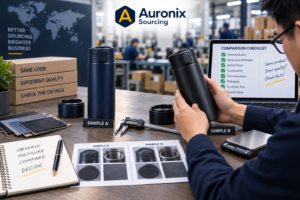
1. Start With the Same Product Specification
Before comparing samples, make sure every supplier received the same product requirements.
If Supplier A was asked to use 1.2 mm stainless steel while Supplier B quoted 0.8 mm, comparing the samples directly would not be fair.
The comparison should begin with one agreed specification covering:
- Material
- Dimensions
- Thickness
- Weight
- Color
- Finish
- Branding
- Accessories
- Packaging
- Performance requirements
This ensures that all suppliers are being evaluated against the same standard.
2. Create a Sample Evaluation Checklist
A structured checklist helps buyers avoid judging samples based only on personal preference.
The checklist can include categories such as:
Material Quality
Does the material match the requested grade or specification?
Dimensions
Are the measurements within the approved tolerance?
Weight
Does the sample match the expected product weight?
Construction
Are components assembled correctly and securely?
Surface Finish
Are there scratches, rough edges, discoloration, or inconsistent coating?
Functionality
Does the product work as intended?
Packaging
Is the product protected properly during transportation?
Using the same checklist for every supplier makes the comparison more consistent.
3. Measure Instead of Guessing
If a specification can be measured, measure it.
Do not simply describe one sample as “slightly bigger” or “heavier.”
Use tools such as:
- Digital calipers
- Measuring tape
- Digital scale
- Thickness gauge
- Color reference
- Hardness tester where required
Record the actual results.
For example:
Target Width: 150 mm
Supplier A: 149.8 mm
Supplier B: 152.5 mm
Tolerance: ±1 mm
This immediately makes the comparison clearer.
4. Compare Material Quality Carefully
Two suppliers may claim to use the same material while delivering noticeably different results.
Compare:
- Material grade
- Thickness
- Density
- Flexibility
- Hardness
- Surface quality
- Weight
For textile products, buyers may check fabric weight, stitching, softness, and color consistency.
For metal products, thickness, finish, welding, and rigidity may matter more.
For plastic products, wall thickness, molding quality, odor, flexibility, and surface finish can be important.
The evaluation criteria should match the product category.
5. Test Real-World Performance
A sample should not only look good on a table.
It should be tested under conditions similar to actual customer use.
Depending on the product, this may involve:
- Opening and closing repeatedly
- Applying weight or pressure
- Testing moving parts
- Checking water resistance
- Testing zippers or buttons
- Assembling and disassembling
- Checking stability
- Testing heat or cold resistance
A product that looks excellent but performs poorly should not receive a high overall score.
Functional performance should usually carry significant weight in the evaluation.
6. Inspect Workmanship in Detail
Small manufacturing details often reveal a supplier’s level of production control.
Check areas such as:
- Stitching consistency
- Welding points
- Mold marks
- Sharp edges
- Glue marks
- Surface scratches
- Logo alignment
- Printing accuracy
- Component fit
- Color differences
Do not inspect only the most visible surfaces.
Look at the bottom, inside, back, joints, seams, and hidden components.
Poor workmanship in these areas can indicate potential quality problems during mass production.
7. Evaluate Packaging Separately
A good product can still arrive damaged if packaging is poorly designed.
Inspect both retail packaging and shipping packaging.
Consider:
- Protection level
- Box strength
- Internal inserts
- Empty space
- Product movement inside the box
- Branding quality
- Carton dimensions
- Packaging weight
Packaging should protect the product without creating unnecessary shipping volume.
For international sourcing, packaging quality and efficiency should be part of the supplier comparison.
8. Use a Scoring System
One of the easiest ways to compare samples objectively is to use a scoring system.
For example:
Material Quality: 20 points
Dimensions & Accuracy: 15 points
Functionality: 20 points
Workmanship: 15 points
Appearance & Finish: 10 points
Packaging: 10 points
Supplier Compliance: 10 points
Total: 100 points
Each supplier can then receive a score based on the same criteria.
This creates a clearer comparison than statements such as “Sample A feels better.”
The scoring weights can also be changed depending on what matters most for the product.
9. Compare Price After Quality Evaluation
Price should be considered, but not before understanding the sample differences.
A supplier that is 10% cheaper may be using:
- Thinner material
- Lower-grade components
- Simpler packaging
- Lower-quality finishing
Another supplier may charge slightly more but deliver better consistency and product performance.
The objective is not to find the cheapest sample.
The goal is to find the best balance between quality, price, reliability, and production capability.
10. Document Every Finding
Photos, measurements, scores, and comments should be recorded for every sample.
This documentation becomes useful during:
- Supplier negotiation
- Sample revisions
- Production approval
- Quality inspection
- Future reorders
For example, instead of writing:
“Handle is weak.”
Write:
“Handle bends noticeably under 8 kg load. Supplier must reinforce the internal structure before final approval.”
Specific feedback is much easier for factories to understand and correct.
11. Request a Revised Sample When Necessary
The first sample does not always need to be perfect.
If a supplier performs well overall but has a few correctable issues, a revised sample may be appropriate.
Provide clear feedback showing:
- What is wrong
- What should be changed
- Target measurement
- Reference photo
- Required material or finish
Once the corrected sample is approved, it should become the production reference.
12. Keep an Approved Reference Sample
Whenever possible, keep an approved physical sample.
The final specification should be:
Approved sample + written specification sheet.
This creates a stronger reference during mass production and quality inspection.
If production units differ significantly from the approved sample, the differences can be identified more easily.
How Auronix Sourcing Helps
At Auronix Sourcing, we help buyers evaluate samples using clear product requirements rather than appearance alone.
Our sourcing process can support:
- Supplier comparison
- Sample coordination
- Product specification clarification
- Material comparison
- Quotation evaluation
- Sample revision communication
- Production follow-up
- Quality-control coordination
- Packaging and logistics planning
A structured comparison process helps buyers choose suppliers based on measurable product performance and overall sourcing capability.
Final Thoughts
Comparing product samples objectively is one of the most important steps before placing a bulk order.
A professional evaluation should consider material, dimensions, weight, functionality, workmanship, finishing, packaging, and compliance with the approved specification.
Using checklists, measurements, testing methods, and scoring systems helps remove personal bias from the decision.
For importers sourcing from China, the best sample is not necessarily the one that looks best at first glance.
It is the sample that most consistently meets the required specification, performs correctly, and can realistically be reproduced during mass production.
Auronix Sourcing
Professional Product Sourcing & Supplier Coordination in China 🇨🇳