
A factory that can comfortably handle your order in March may struggle to offer the same lead time in September.
The machinery has not disappeared. The production lines may be the same. The workforce may even be similar.
What changed is demand for that capacity.
During peak manufacturing periods, factories receive more purchase orders while upstream suppliers, packaging companies, subcontractors, and logistics providers experience the same pressure. Production slots fill earlier, material lead times increase, and the amount of immediately available capacity falls.
For importers sourcing from China, understanding how production capacity changes during peak demand is essential for avoiding missed launches, stockouts, rushed production, and expensive shipping decisions.
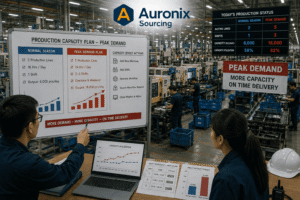
Maximum Capacity Is Not Available Capacity
When a supplier says:
“Our monthly capacity is 500,000 units,”
that number can be misleading if interpreted incorrectly.
The factory may technically be capable of producing 500,000 units under certain operating conditions.
But part of that capacity may already be reserved for:
- Existing customers
- Repeat orders
- Long-term contracts
- Orders currently in production
What matters to a new buyer is not theoretical maximum capacity.
It is how much suitable capacity remains available during the required production window.
Peak Demand Fills Production Slots Earlier
During normal periods, a factory may have open production capacity only a few weeks ahead.
During peak season, customers begin reserving production much earlier.
As orders accumulate, the schedule fills.
A buyer approaching the factory late may hear:
“We can produce it, but the earliest start date is six weeks from now.”
The factory still has manufacturing capability.
It simply does not have immediate capacity.
Different Industries Have Different Peak Seasons
There is no single peak manufacturing season for every factory.
Demand patterns depend on the products being manufactured.
Factories may become particularly busy before:
- Holiday retail periods
- Back-to-school seasons
- Summer demand
- Major ecommerce sales periods
- Industry-specific events
- Chinese New Year
Importers should understand the seasonal cycle of their particular supply chain.
Existing Customers May Reserve Capacity First
Factories often prioritize predictable repeat business when planning capacity.
Long-term customers may provide:
- Annual forecasts
- Regular purchase schedules
- Recurring order quantities
This allows manufacturers to anticipate future production requirements.
A new customer arriving during peak season may therefore compete only for the capacity remaining after existing commitments.
Strong supplier relationships can become particularly valuable when factories are busy.
Large Orders Can Occupy Lines for Weeks
A high-volume order may consume substantial production capacity.
If one customer places an order requiring three weeks of continuous production on a specific line, smaller customers may need to be scheduled around it.
The effect becomes more significant when several major buyers place orders simultaneously.
This is why a factory’s schedule can change quickly during high-demand periods.
Raw-Material Suppliers Become Busy Too
Factory capacity is only one part of the problem.
Upstream suppliers may also receive unusually high demand for:
- Plastic resin
- Metal
- Fabric
- Electronic components
- Hardware
Lead times can increase.
A factory may have an open production line but still be unable to begin because a critical material has not arrived.
Peak-season planning therefore needs to consider the broader supply chain.
Component Shortages Can Reduce Effective Capacity
For products containing specialized components, shortages can become particularly disruptive.
Imagine a factory capable of assembling 20,000 units per day.
If it receives enough motors for only 8,000 units per day, its theoretical assembly capacity becomes irrelevant.
The component supply becomes the constraint.
Professional buyers should identify important long-lead components before peak production periods begin.
Packaging Suppliers Also Reach Capacity
Custom packaging is frequently overlooked.
During busy periods, packaging factories may experience increased demand for:
- Printed boxes
- Inserts
- Labels
- Master cartons
Products can therefore finish manufacturing but remain unable to ship because packaging is late.
Packaging lead times should be confirmed alongside the main production schedule.
Subcontractors Become Bottlenecks
Many manufacturers outsource specialized processes such as:
- Printing
- Plating
- Surface treatment
- Heat treatment
- Specialized components
Those subcontractors may serve multiple factories simultaneously.
During peak demand, their capacity can become a bottleneck affecting many downstream manufacturers.
This is why understanding outsourced processes can help buyers evaluate production risk.
Factories May Add Overtime
One way manufacturers respond to higher demand is by extending operating hours.
They may introduce:
- Overtime
- Additional shifts
- Weekend production
This can increase short-term output.
However, overtime has limits.
Workers become fatigued, equipment requires maintenance, and quality-control resources must also scale.
Importers should not assume that a factory can increase output indefinitely simply by working longer hours.
Factories May Hire Temporary Workers
Additional labor can increase capacity for relatively standardized tasks.
Temporary workers may support:
- Assembly
- Packing
- Material handling
However, new employees may have less experience.
Without adequate training and supervision, rapid workforce expansion can increase variation and workmanship defects.
For quality-sensitive products, production monitoring may become particularly important during peak periods.
Production Lines May Run Faster
Factories under heavy demand may attempt to increase throughput.
That can improve output when the process has genuine unused efficiency.
But excessive pressure on line speed can create risks involving:
- Assembly errors
- Missed process checks
- Workmanship variation
Buyers should be cautious about demanding unrealistic acceleration.
Faster manufacturing has little value if the result is a rejected batch.
Quality-Control Capacity Can Become Stretched
Production is not the only department experiencing increased workload.
Factory QC teams may need to inspect significantly more products.
If quality resources do not expand with output, inspections can become rushed.
This is why buyers should maintain agreed quality requirements during busy seasons rather than assuming factory controls will automatically remain identical.
Equipment Utilization Increases
During quieter periods, factories may have spare machine capacity.
During peak demand, critical equipment can operate close to maximum utilization.
Higher utilization can mean less flexibility when:
- A machine breaks
- Tooling requires repair
- An urgent order appears
A small disruption that would be easy to absorb during a quiet month can create larger scheduling consequences when every production line is already occupied.
Maintenance Still Has to Happen
Machines require maintenance regardless of customer deadlines.
Factories that postpone essential maintenance to maximize short-term output can increase the risk of breakdowns.
Well-managed manufacturers balance production pressure with equipment reliability.
For importers, consistent delivery depends on sustainable capacity management rather than simply maximum machine utilization.
Lead Times Usually Increase
When demand exceeds readily available capacity, lead times tend to expand.
A product that normally requires four weeks from confirmation to completion might require six or eight weeks during a busy period.
The exact change depends on:
- Product complexity
- Materials
- Factory workload
- Supplier network
Buyers should therefore reconfirm lead times rather than relying on numbers from previous orders.
MOQ Can Become Less Flexible
During quiet periods, a factory may accept smaller orders to keep production lines utilized.
During peak season, the same factory may have enough large orders to operate at full capacity.
Small orders become less attractive.
As a result, manufacturers may become less flexible about:
- MOQ
- Small customization runs
- Short production runs
This is another reason small importers should plan peak-season orders early.
Negotiating Power Can Shift
When a factory has unused capacity, buyers may have stronger leverage.
When the production schedule is nearly full, the situation changes.
The supplier has less incentive to accept:
- Extremely aggressive pricing
- Difficult payment conditions
- Very small orders
- Unrealistic deadlines
Timing therefore affects negotiation power.
The best commercial negotiation does not always happen when factory demand is at its highest.
Chinese New Year Creates Unique Capacity Pressure
Chinese New Year can create one of the most significant disruptions in China’s manufacturing calendar.
The effect can begin before official closures as:
- Workers leave early
- Suppliers stop accepting new orders
- Production backlogs increase
After the holiday, factories may need time to return to normal staffing and output.
Buyers should therefore plan around the broader disruption period rather than only the official holiday dates.
Production Slots Can Become More Valuable
For important seasonal orders, buyers may need to discuss production scheduling before every detail is finalized.
This does not mean committing blindly.
It means understanding:
- When capacity is available
- What approvals are required
- When materials must be ordered
- When the production slot becomes firm
The earlier these dependencies are understood, the easier it becomes to create a realistic launch schedule.
Forecasting Helps Repeat Buyers
Businesses placing recurring orders can provide suppliers with realistic demand forecasts.
For example:
January: 10,000 units
April: approximately 15,000 units
August: approximately 30,000 units
The numbers should reflect genuine expectations rather than exaggerated promises.
Forecast visibility can help suppliers discuss material planning and production capacity before purchase orders arrive.
Buyers Should Order Earlier
One of the simplest responses to peak-season capacity risk is moving procurement decisions earlier.
Earlier ordering provides more time for:
- Sample approval
- Material procurement
- Production
- Inspection
- Rework
- Shipping
The goal is not merely to start manufacturing earlier.
It is to create more room for the unexpected.
Avoid Last-Minute Design Changes
Peak season is an especially poor time for unnecessary specification changes.
A revision may require:
- New samples
- Different materials
- New packaging
- Tooling adjustments
By the time these changes are complete, the original production slot may have disappeared.
Freeze product specifications as early as practical.
Monitor Materials Before Production
Do not assume that a confirmed production date means all required materials are ready.
Before the planned start, confirm the status of critical:
- Materials
- Components
- Packaging
This can reveal likely delays before the factory misses the official production date.
Early visibility provides more options.
Maintain Inventory Buffers
Businesses relying on extremely lean inventory become vulnerable during seasonal capacity constraints.
Appropriate safety stock can protect against:
- Longer production lead times
- Quality rework
- Freight delays
- Customs delays
The correct inventory buffer depends on demand, product value, storage cost, and supply-chain risk.
Maintain a Qualified Backup Supplier
A second qualified manufacturer can reduce dependency on one factory’s production schedule.
However, the backup supplier may also become busy during the same peak period.
This is why backup factories should be identified and evaluated before demand increases.
For critical products, supplier diversification should form part of long-term planning rather than emergency sourcing.
How Auronix Sourcing Helps Manage Peak Production
Auronix Sourcing helps businesses plan sourcing and manufacturing around periods of changing factory capacity.
Support can include supplier capacity evaluation, production forecasting coordination, material and component follow-up, production scheduling, supplier communication, factory visits, production monitoring, quality inspection, packaging coordination, backup supplier development, shipment consolidation, and international shipping coordination.
By communicating expected production requirements earlier and monitoring important milestones, Auronix helps businesses identify capacity constraints before they become urgent inventory problems.
Conclusion
Factory production capacity is not a fixed number available equally to every buyer throughout the year.
During peak demand, production lines fill, materials become harder to secure, subcontractors become overloaded, packaging lead times increase, workers face heavier workloads, and quality-control resources can become stretched.
The result is usually less immediately available capacity and longer lead times.
Importers can reduce these risks by understanding their industry’s seasonal manufacturing cycle, forecasting demand, confirming capacity earlier, securing materials, freezing specifications, maintaining inventory buffers, and qualifying backup suppliers.
With Auronix Sourcing, businesses can coordinate factory capacity, production schedules, materials, quality control, packaging, and international logistics—helping keep supply chains more predictable when manufacturing demand reaches its busiest periods.