
When a supplier tells you that your order will take 30 days to produce, it is easy to imagine your products moving through the factory continuously for the entire month.
That is usually not what happens.
Most established factories manufacture orders for multiple customers simultaneously. Production lines, machines, tooling, workers, raw materials, subcontractors, and packaging resources must be coordinated across many purchase orders.
Your order therefore becomes part of a much larger production schedule.
Understanding how factories manage multiple customers can help importers interpret lead times more accurately, avoid unrealistic delivery expectations, and prepare for periods when manufacturing capacity becomes tight.
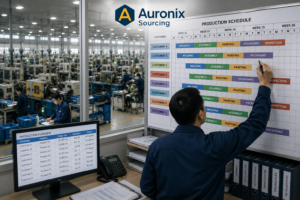
A Factory Has Limited Production Capacity
Every manufacturer has practical limits.
Those limits may involve:
- Number of production lines
- Machine availability
- Skilled workers
- Tooling
- Assembly capacity
- Quality-control resources
- Warehouse space
A factory cannot necessarily start every new order immediately after receiving a deposit.
Even when materials are available, the required production line may already be occupied by another customer’s order.
This is why order confirmation and production start date are not always the same date.
Orders Enter a Production Queue
Once an order is confirmed, the factory typically needs to determine when it can enter production.
The schedule may consider:
- Order quantity
- Product complexity
- Required machinery
- Material availability
- Tooling
- Customer deadline
- Existing commitments
A relatively simple order might fit into available capacity quickly.
A specialized product requiring a particular machine may have to wait until that equipment becomes available.
Material Availability Influences Scheduling
Production cannot begin if critical materials or components have not arrived.
Factories may need to purchase:
- Raw materials
- Electronic components
- Hardware
- Accessories
- Packaging
If one important component is delayed, the factory may temporarily move another customer’s order forward.
This helps keep machines and workers productive, but it can also change the original production sequence.
Supply planning and production scheduling are therefore closely connected.
Different Products Compete for Different Resources
Not every customer order competes for exactly the same factory capacity.
Imagine a factory with:
- Several injection-molding machines
- Two assembly lines
- One printing area
- One packaging section
Two products may be molded simultaneously but later require the same assembly line.
The bottleneck moves through the factory.
A manufacturer therefore has to schedule individual production processes—not simply entire customer orders.
Tooling Can Determine Production Sequence
Products requiring dedicated molds, dies, fixtures, or other tooling create additional scheduling considerations.
Changing from one product to another may require:
- Removing tooling
- Installing new tooling
- Adjusting machines
- Testing settings
- Approving initial output
These changeovers consume time.
Factories often try to organize similar production runs efficiently to reduce unnecessary setup.
This can influence when your particular product enters production.
Order Size Matters
A large order can occupy significant factory capacity.
For example, a customer ordering 100,000 units may require a production line for several weeks.
Meanwhile, smaller orders may need to be scheduled before, after, or around that production run.
However, larger orders do not automatically receive priority in every situation.
Factories must balance existing commitments, customer relationships, materials, and production efficiency.
Repeat Customers May Receive Priority
Long-term customers can have scheduling advantages.
A buyer placing regular orders may provide the factory with predictable annual demand.
That can allow production planners to reserve capacity in advance.
Strategic customers may also receive additional attention during busy periods because the factory wants to protect an important commercial relationship.
This is one reason stable supplier relationships can create benefits beyond unit price.
Urgent Orders Can Disrupt the Schedule
Factories sometimes receive customers asking for expedited production.
Accommodating an urgent order may require:
- Overtime
- Additional shifts
- Schedule changes
- Moving other orders
Not every factory will agree to this.
Even when it does, importers should understand that pushing production faster can create additional operational pressure.
An aggressive schedule should never become an excuse for reducing quality-control requirements.
Production Lead Time Includes More Than Machine Time
A product may require only a few days of actual machine production while the quoted lead time is several weeks.
That difference can include:
Material Procurement → Production Queue → Machine Setup → Manufacturing → Assembly → Testing → Packaging
Therefore, asking:
“How many days does it take to make the product?”
may not provide enough information.
A more useful question is:
“When can production start, and when is the complete order expected to be ready?”
Factories Use Production Planning Systems
More organized manufacturers may use production-planning systems to coordinate:
- Purchase orders
- Materials
- Machines
- Workers
- Production stages
- Delivery dates
Smaller factories may use simpler scheduling methods.
The sophistication of the system matters less than whether the factory can realistically manage capacity and meet commitments.
During supplier evaluation, production planning can provide useful insight into operational maturity.
Bottlenecks Determine Real Capacity
A factory may advertise impressive monthly capacity, but the true output of your product may depend on one bottleneck.
For example:
- Molding capacity: 100,000 units/week
- Printing capacity: 80,000 units/week
- Assembly capacity: 50,000 units/week
The assembly stage may effectively determine how quickly finished products can be completed.
When evaluating capacity, ask about the complete manufacturing process rather than one machine or department.
Subcontractors Affect the Schedule
Factories often outsource certain processes.
These may include:
- Surface treatment
- Printing
- Plating
- Heat treatment
- Specialized components
- Packaging
The factory’s schedule may therefore depend partly on external suppliers.
A subcontractor delay can affect the final production date even when the main factory is operating normally.
For customized products, understanding which processes are outsourced can help identify potential scheduling risks.
Packaging Has Its Own Timeline
Importers often focus on the product and forget that custom packaging must also be manufactured.
Retail boxes, labels, inserts, protective materials, and master cartons may come from separate packaging suppliers.
If products are finished but packaging is delayed, the shipment may still not be ready.
Professional production scheduling therefore includes packaging preparation rather than treating it as a last-minute activity.
Peak Seasons Change Everything
Factory capacity becomes more difficult to secure during periods of high demand.
Depending on the industry, busy periods may occur before:
- Major retail seasons
- Holiday sales periods
- Industry-specific peaks
- Chinese New Year
Factories may receive more orders than normal while also facing pressure on materials, components, labor, and logistics.
Lead times that were realistic during a quiet month may become impossible during peak season.
Chinese New Year Requires Early Planning
Chinese New Year can have a significant impact on manufacturing schedules.
The disruption is not limited to the official holiday dates.
Factories and upstream suppliers may experience changes before and after the holiday due to:
- Worker departures
- Reduced production
- Supplier shutdowns
- Production backlogs
- Gradual workforce return
Importers should therefore plan orders well in advance rather than assuming production will continue normally until the final working day.
Late Buyer Approvals Can Lose Production Slots
Sometimes the factory is not responsible for the delay.
A buyer may take too long to approve:
- Samples
- Artwork
- Packaging
- Colors
- Specifications
Meanwhile, the factory cannot leave production capacity unused indefinitely.
Another customer’s order may be scheduled into the available slot.
When the buyer finally approves everything, the next available production window may be later than expected.
Timely approvals are therefore part of effective production management.
Last-Minute Specification Changes Can Reschedule an Order
Changing the product after production planning has begun can affect:
- Materials
- Components
- Tooling
- Packaging
- Machine setup
A seemingly small change may require new materials or supplier lead times.
The factory may then need to move the order to a later production slot.
This is why specifications should be finalized before mass production whenever possible.
Ask for a Realistic Production Schedule
Instead of accepting a general statement such as:
“Production takes around 30 days,”
ask for important milestones.
Depending on the project, these may include:
- Material preparation
- Planned production start
- Assembly
- Packaging
- Expected completion
For important orders, milestone visibility can help buyers identify delays earlier.
Monitor Production Progress
Once production begins, maintain structured communication.
Useful questions include:
- Have all materials arrived?
- Has production started?
- What percentage is completed?
- Has packaging started?
- Is the completion date still realistic?
For significant orders, independent production monitoring or factory visits may provide additional visibility.
Do not wait until the expected completion date to discover that production has barely started.
Avoid Artificially Short Deadlines
Buyers sometimes pressure factories into promising unrealistic schedules.
The supplier may agree because it does not want to lose the order.
That does not create additional manufacturing capacity.
Instead, unrealistic deadlines can increase the risk of:
- Overtime
- Rushed assembly
- Reduced process control
- Shipping delays
A realistic production schedule is usually more valuable than an attractive promise that cannot be achieved.
Maintain a Buffer in Your Inventory Planning
Importers should avoid planning inventory around the assumption that every production order and shipment will arrive on the earliest possible date.
Build appropriate time buffers for:
- Production variation
- Inspection
- Rework
- Freight delays
- Customs
The correct buffer depends on the product, supply chain, and business model.
Better inventory planning reduces the pressure to turn every production order into an emergency.
Build a Strong Supplier Relationship
Reliable repeat customers can become easier for factories to plan around.
Sharing realistic forecasts may help suppliers anticipate:
- Future quantities
- Production frequency
- Seasonal demand
Forecasts are not guarantees, but they can improve capacity discussions.
A factory that understands your purchasing cycle can potentially plan future production more effectively than one receiving unpredictable urgent orders.
Keep a Backup Supplier
Even strong production planning cannot eliminate every capacity problem.
For important products, a qualified backup supplier can reduce dependency on one factory.
The backup should ideally be:
- Verified
- Sampled
- Commercially evaluated
A random supplier contact is not a meaningful contingency plan.
Supplier redundancy can become particularly valuable when the primary factory reaches full capacity during peak periods.
How Auronix Sourcing Manages Factory Production Scheduling
Auronix Sourcing helps businesses coordinate production schedules with Chinese manufacturers as part of the wider sourcing process.
Support can include supplier selection, capacity evaluation, sample and specification approval, material follow-up, production scheduling, factory communication, production monitoring, factory visits, quality inspection, packaging coordination, shipment consolidation, and international shipping.
For repeat orders, Auronix can also help businesses communicate purchasing forecasts and expected timelines earlier so production and logistics can be planned more effectively.
Conclusion
Factories do not manufacture one customer’s order in isolation.
They continuously balance multiple customers, materials, machinery, tooling, workers, subcontractors, packaging suppliers, and delivery deadlines.
Your production lead time therefore depends not only on how quickly the product can physically be manufactured, but also on when the factory has the resources and capacity available to manufacture it.
Importers can reduce scheduling problems by finalizing specifications early, approving samples promptly, ordering before peak periods, monitoring production milestones, maintaining realistic inventory buffers, and developing qualified backup suppliers.
With Auronix Sourcing, businesses can coordinate supplier capacity, production schedules, quality inspections, packaging, and international logistics—helping create a more predictable path from purchase order to finished shipment.