
A factory can have dozens of machines, hundreds of workers, and enough raw materials to produce thousands of units per day—and still miss a delivery deadline because of one overloaded production stage.
That stage is the bottleneck.
A production bottleneck occurs when one part of the manufacturing process has less capacity than the stages feeding into it. Products begin accumulating before that operation, downstream processes wait for output, and the entire production schedule can slow down.
For importers sourcing from China, understanding bottlenecks is important because a supplier’s advertised
does not always represent the number of finished products it can actually deliver.
The real output of a factory is often determined by its slowest critical process.
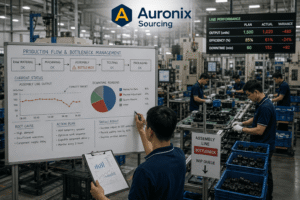
What Does a Production Bottleneck Look Like?
Imagine a product passing through four manufacturing stages:
Molding → Printing → Assembly → Packaging
The factory can process:
- 20,000 molded parts per day
- 15,000 printed parts per day
- 8,000 assembled products per day
- 12,000 packaged products per day
The factory cannot realistically produce 20,000 finished units per day.
Assembly can handle only 8,000.
Products will begin accumulating before assembly, making that stage the primary bottleneck.
Why Bottlenecks Matter to Importers
Bottlenecks affect much more than factory efficiency.
They can influence:
- Production lead time
- Shipment dates
- Inventory availability
- Overtime costs
- Quality consistency
A supplier may appear to have significant capacity based on its machinery, but if one critical operation is overloaded, finished output can remain limited.
This is why buyers should evaluate the complete production process rather than one impressive department.
Bottlenecks Can Move
A factory does not necessarily have one permanent bottleneck.
The constraint can change depending on:
- Product
- Order mix
- Quantity
- Worker availability
- Equipment condition
- Material supply
For one product, injection molding may be the slowest stage.
For another, final assembly may become the constraint.
During a busy period, packaging could suddenly become the bottleneck because several large orders finish production simultaneously.
Production planning must therefore be dynamic.
Material Shortages Can Stop Production
Not every bottleneck occurs inside the factory.
A missing component can become the most important constraint in the entire order.
Imagine that 95% of the materials are ready, but a specialized motor has not arrived.
The factory may be unable to complete assembly.
This is why manufacturers monitor:
- Raw-material availability
- Component delivery dates
- Supplier lead times
For customized products, long-lead-time components should be identified early.
Equipment Can Create Capacity Constraints
Certain manufacturing processes depend on specialized machines.
Examples may include:
- Injection-molding machines
- CNC equipment
- Die-casting machines
- Printing equipment
- Testing systems
If several customer orders require the same equipment, a queue can develop.
Equipment breakdowns can make the situation worse.
Factories may respond by rescheduling production, adding shifts, or using compatible equipment where technically appropriate.
Tooling Can Become a Bottleneck
Custom molds, dies, fixtures, and jigs can also limit production.
A factory may have available machinery but insufficient tooling to run multiple production cycles simultaneously.
Producing additional tooling can increase capacity, but it requires:
- Investment
- Development time
- Validation
Whether this is commercially worthwhile depends on expected production volume and long-term demand.
Skilled Labor Can Limit Output
Some manufacturing operations depend heavily on trained workers.
Examples may include:
- Precision assembly
- Welding
- Sewing
- Hand finishing
- Technical testing
Hiring additional workers does not immediately solve the problem if significant training is required.
Factories may cross-train employees so workers can move between operations as production demand changes.
This creates more flexibility during capacity peaks.
Quality Problems Can Create Hidden Bottlenecks
A production stage may appear fast until defects begin appearing.
If products repeatedly require:
- Rework
- Retesting
- Repair
- Replacement
the effective capacity of the factory falls.
Quality problems can therefore create bottlenecks even when machinery and labor appear sufficient.
Professional factories try to identify the root cause rather than allowing defective products to continue moving through production.
Factories Use Work-in-Progress Data
Factories can monitor work in progress (WIP) to identify where production is accumulating.
If large quantities of semi-finished products consistently wait before one operation, that is a strong indication of a constraint.
Production managers may track:
- Input quantity
- Output quantity
- Queue size
- Cycle time
This helps determine where additional resources or process improvements are required.
Production Scheduling Helps Control Bottlenecks
A factory manufacturing for multiple customers cannot simply run every order whenever it arrives.
Production planners may schedule orders based on:
- Machine availability
- Material readiness
- Tooling
- Worker capacity
- Delivery deadlines
By sequencing production carefully, factories can reduce unnecessary changeovers and prevent excessive pressure on constrained processes.
Poor scheduling can create bottlenecks even when overall factory capacity appears sufficient.
Factories May Add Overtime
One short-term response to a bottleneck is additional working hours.
Factories may use:
- Overtime
- Additional shifts
- Weekend production
This can temporarily increase output.
However, excessive overtime can introduce risks involving worker fatigue, mistakes, and inconsistent workmanship.
Importers should not assume that faster production automatically produces better results.
Quality controls should remain in place.
Workers Can Be Reallocated
If one operation becomes overloaded while another has spare labor, management may move trained employees to the constrained stage.
For example, additional workers might support:
- Assembly
- Inspection
- Packaging
This works best when tasks are relatively standardized and employees have appropriate training.
For specialized technical operations, worker reallocation may be much more difficult.
Additional Equipment Can Increase Capacity
For long-term bottlenecks, manufacturers may invest in additional machinery.
This can make sense when:
- Demand is stable
- Order volumes are increasing
- Equipment utilization remains consistently high
However, purchasing equipment requires capital and may require additional floor space, operators, maintenance, and supporting infrastructure.
Factories generally need confidence that future demand justifies the investment.
Process Improvement Can Remove the Constraint
Sometimes the best solution is not more equipment or workers.
The factory may redesign the workflow.
Improvements could involve:
- Reducing unnecessary movement
- Changing workstation layout
- Improving fixtures
- Simplifying assembly
- Automating repetitive operations
Small process improvements can sometimes create substantial increases in throughput.
This is particularly valuable when the bottleneck involves a repetitive manufacturing operation.
Product Design Can Create Bottlenecks
A product itself may be difficult to manufacture efficiently.
For example, a design might require:
- Excessive manual assembly
- Difficult alignment
- Too many fasteners
- Unnecessarily tight tolerances
Design for Manufacturability (DFM) can help identify these issues.
A relatively small design change may reduce assembly time and improve consistency without changing the product’s core functionality.
For high-volume production, these improvements can have significant economic value.
Factories May Use Subcontractors
When internal capacity becomes insufficient, manufacturers may outsource selected processes.
These might include:
- Surface finishing
- Printing
- Plating
- Component production
Subcontracting can increase flexibility, but it introduces additional quality and traceability considerations.
Buyers should understand which critical processes are performed internally and how outsourced operations are controlled.
Unauthorized subcontracting can create additional sourcing risk.
Quality Inspection Can Become a Bottleneck
Quality control itself requires capacity.
If thousands of products finish assembly simultaneously but the factory has insufficient inspection resources, products may wait before packaging or shipment.
Factories can address this through:
- Additional inspectors
- Better in-process quality control
- Improved testing equipment
The objective should not be to reduce inspection merely to accelerate shipment.
That can transfer the factory’s production problem directly to the buyer.
Packaging Can Become the Final Constraint
A product is not ready to ship simply because manufacturing is complete.
Custom:
- Boxes
- Inserts
- Labels
- Protective packaging
- Master cartons
must also be available.
If packaging arrives late or the packing line lacks sufficient capacity, finished goods can remain inside the factory waiting for completion.
Packaging therefore needs to be included in production planning from the beginning.
Buyers Can Accidentally Create Bottlenecks
Not every production delay originates with the manufacturer.
Importers can create bottlenecks by delaying:
- Sample approval
- Artwork
- Color confirmation
- Packaging approval
- Specification decisions
A factory may have reserved production capacity, but if the buyer is not ready, that capacity may be assigned to another order.
Organized and timely approvals help maintain production schedules.
How Buyers Can Identify Bottleneck Risk
Before placing a major order, ask the supplier about the manufacturing process.
Useful questions include:
- What is the slowest production stage?
- Which processes are outsourced?
- What is the realistic finished-product capacity?
- Are any components long-lead items?
- Is the factory approaching peak capacity?
These questions provide more insight than simply asking:
“What is your monthly capacity?”
Monitor Production Milestones
Once mass production begins, buyers should monitor important milestones.
Depending on the product, these may include:
Materials Ready → Production Started → Assembly → Packaging → Final Inspection
If one milestone repeatedly moves while others remain complete, a bottleneck may have developed.
Identifying it early gives the factory more time to implement corrective action.
Do Not Solve Every Bottleneck With Speed
When delays occur, the buyer’s first response may be:
“Please produce faster.”
That does not identify the underlying problem.
If the bottleneck is a missing component, adding assembly workers will accomplish nothing.
If the problem is quality-related rework, increasing line speed may make it worse.
The first step should be identifying the actual constraint.
Then the appropriate solution can be selected.
How Auronix Sourcing Helps Manage Production Bottlenecks
Auronix Sourcing helps businesses maintain visibility into manufacturing progress and potential production constraints.
Support can include supplier capacity assessment, production planning coordination, material and component follow-up, factory communication, production monitoring, factory visits, quality inspection, packaging coordination, backup supplier development, shipment consolidation, and international shipping coordination.
For customized products, Auronix can also help coordinate specifications and production requirements before manufacturing begins, reducing the risk that avoidable design, material, or approval issues become bottlenecks later.
Conclusion
A factory’s production capacity is ultimately determined by the slowest critical stage required to create a finished product.
That constraint might be a machine, worker, component, mold, assembly line, testing station, subcontractor, or packaging process.
Well-managed factories identify these bottlenecks and respond through better scheduling, worker allocation, process improvements, additional equipment, controlled subcontracting, or design optimization.
Importers can reduce bottleneck risk by understanding the complete manufacturing process, confirming realistic capacity, finalizing specifications early, monitoring production milestones, and avoiding unrealistic deadlines.
With Auronix Sourcing, businesses can monitor factory production, identify potential constraints, coordinate suppliers and materials, manage quality inspections, and organize packaging and logistics—helping keep production moving from approved order to finished shipment.