
A product has been approved. The factory has received the purchase order. Materials are being prepared, and mass production is approaching.
Then the buyer requests a change.
Perhaps the logo needs to move. A component should be upgraded. The packaging needs a different dimension. A color needs adjustment. Or a customer test reveals a design problem that cannot be ignored.
To the buyer, the modification may appear small. Inside a factory, however, even a minor design change can affect materials, tooling, components, production instructions, quality standards, packaging, cost, and the production schedule.
Understanding how factories handle last-minute design changes helps importers decide when a modification is worth making—and when it may create more risk than value.
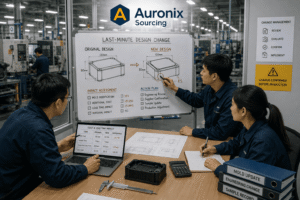
The Factory First Determines the Production Stage
The impact of a design change depends heavily on when it is requested.
There is a major difference between changing a product:
- Before materials are ordered
- After materials are ordered
- Before production starts
- During production
- After production is completed
Generally, the later the change occurs, the more expensive and disruptive it can become.
A modification that takes a few hours during sample development could require substantial rework once thousands of units have already entered production.
The Change Request Must Be Defined Clearly
Factories cannot reliably act on vague instructions such as:
“Make this section slightly bigger.”
The buyer should specify exactly what is changing.
Depending on the product, that may require:
- Updated drawings
- Revised dimensions
- New artwork
- Material specifications
- Color references
- Component information
The new revision should be clearly distinguishable from the previously approved version.
This is basic revision control, and it becomes increasingly important as product complexity grows.
Engineering Reviews the Change
For customized products, the sales representative should not be the only person evaluating a design modification.
The factory may need engineering or production personnel to determine whether the requested change is technically practical.
They may evaluate:
- Manufacturability
- Materials
- Tolerances
- Tooling
- Assembly
- Product performance
A modification that looks simple on a computer rendering may create significant manufacturing complications.
The Factory Checks Material Impact
Suppose the buyer changes the product material after the original material has already been purchased.
The factory must determine what happens to the existing inventory.
Possible consequences include:
- Unusable materials
- Additional purchasing
- Higher MOQ
- Longer material lead time
The buyer may be responsible for costs associated with materials already purchased specifically for the order, depending on the commercial agreement.
This is why specifications should be finalized before procurement whenever possible.
Components May Need to Be Reordered
A design modification may affect one or more components.
For example, changing the dimensions of an electronic product could require a different:
- Battery
- PCB
- Connector
- Switch
- Housing
These components may come from external suppliers.
The main factory must then obtain new quotations, confirm availability, and potentially wait for new component production.
A seemingly small change can therefore restart part of the supply chain.
Tooling Changes Can Be Expensive
Products manufactured using custom tooling require special attention.
Changing the design may require modifications to:
- Injection molds
- Dies
- Jigs
- Fixtures
Some tooling can be modified relatively easily.
Other changes may require substantial reworking or completely new tooling.
The supplier should confirm the technical and financial implications before making irreversible changes.
Packaging May Also Need to Change
Product modifications can affect packaging unexpectedly.
If the product becomes larger, smaller, heavier, or differently shaped, existing:
- Retail boxes
- Inserts
- Protective materials
- Master cartons
may no longer fit correctly.
Printed packaging can also become obsolete if specifications, instructions, or product images change.
Packaging should therefore be included in every design-change review.
Compliance May Need to Be Reconsidered
For regulated products, certain modifications can affect testing or compliance requirements.
Changes to components, materials, electrical systems, or other relevant characteristics may require additional evaluation.
Importers should not assume that a previously tested or compliant product automatically remains covered after significant design changes.
Where required, appropriate testing, regulatory, or professional compliance advice should be obtained.
The Factory Calculates the Cost Impact
Once the technical impact is understood, the supplier can evaluate additional costs.
These may involve:
- New materials
- Components
- Tooling modifications
- Sample development
- Packaging
- Rework
The buyer should request written confirmation of additional charges before approving the modification.
Avoid discovering the financial impact after the factory has already implemented the change.
The Production Schedule Is Recalculated
A design change can affect the planned production slot.
If new materials require two additional weeks, the original manufacturing window may no longer be available.
The factory might need to schedule another customer’s order during the delay.
When your materials finally arrive, your order could move to the next available production slot.
This means a two-week material delay can sometimes create a larger overall production delay.
A Revised Sample May Be Required
For meaningful changes, approving a new sample before mass production can reduce risk.
The revised sample may confirm:
- Dimensions
- Materials
- Functionality
- Appearance
- Branding
- Packaging fit
Skipping sample approval to save several days can be dangerous if the change affects product performance or appearance.
The appropriate level of validation depends on the modification.
Approved Samples Must Be Updated
If a new sample is approved, the previous sample should no longer be treated as the final production reference for the changed features.
Factories and buyers should clearly identify the current approved version.
This prevents a common production problem:
The buyer thinks Version 3 is approved while the production team is still following Version 2.
Version control becomes especially important when several revisions happen quickly.
Production Documents Need Updating
A product change may require revisions to internal factory documentation.
This can include:
- Technical drawings
- Bill of materials
- Assembly instructions
- Quality requirements
- Packaging instructions
Updating only the sales team’s email is not enough.
The information must reach the people actually manufacturing and inspecting the product.
Quality Inspection Criteria Must Change
If the product specification changes, inspection requirements may also need to change.
Suppose a dimension changes from 100 mm to 105 mm.
An inspector using the old specification could incorrectly reject acceptable products—or approve products made to the outdated requirement.
Inspection documentation should therefore match the latest approved revision.
What Happens If Production Has Already Started?
Changes become significantly more complicated once mass production is underway.
The factory first needs to determine:
- How many units are complete?
- How many are partially complete?
- Which materials have been consumed?
- Can existing products be modified?
The buyer may have several options.
For example:
Option A: Finish the current order using the original approved design.
Option B: Stop production and implement the change.
Option C: Complete part of the order under the original design and produce the remaining quantity under the revised version.
The best option depends on cost, urgency, product risk, and commercial priorities.
Rework May Be Possible
Some completed products can be modified.
For example, the factory might be able to replace:
- Labels
- Packaging
- Certain components
- Accessories
Other changes may make rework economically impractical.
Rework also introduces additional handling and quality risks, so modified units should be appropriately checked afterward.
Stopping Production Has a Cost
Buyers sometimes assume a factory can simply stop the line without consequences.
In reality, stopping production may affect:
- Workers
- Machine schedules
- Material usage
- Other customer orders
The factory may need to reorganize its schedule.
This is why significant changes after production begins can create additional charges or delays.
Some Changes Should Wait Until the Next Order
Not every improvement needs to be implemented immediately.
Suppose production has already reached 80%, and the buyer wants a minor cosmetic improvement that does not affect safety, compliance, functionality, or agreed quality.
It may be more practical to finish the current production run and implement the improvement in the next order.
This avoids unnecessary rework and schedule disruption.
Each situation should be evaluated based on the commercial and technical impact.
Critical Problems Should Not Be Ignored
There is an important exception.
If a design issue creates a serious concern involving:
- Safety
- Compliance
- Core functionality
- Major product failure
continuing production simply to protect the delivery date may create much greater problems later.
In such cases, the appropriate technical and compliance implications should be evaluated before proceeding.
Protecting a production schedule should not take priority over critical product requirements.
Buyers Need an Engineering Change Process
Businesses developing custom products should establish a simple Engineering Change Request (ECR) or similar change-control process.
Every significant change should identify:
- Current revision
- Requested modification
- Reason for change
- Technical impact
- Cost impact
- Schedule impact
- Approval status
This creates traceability and reduces confusion between buyers, suppliers, engineers, production teams, and inspectors.
Avoid Verbal-Only Changes
Important production modifications should never depend entirely on phone calls or chat messages.
Document the final approved change.
Where appropriate, provide revised drawings, specifications, artwork, or other controlled files.
Clear documentation protects both buyer and supplier from later disagreements about what was requested.
Freeze the Design Before Mass Production
The best way to manage last-minute changes is to reduce the number of unnecessary changes in the first place.
Before mass production, complete appropriate:
Prototype → Testing → Revision → Final Sample → Design Freeze
The exact development process depends on the product.
The objective is to identify major issues while changes are still relatively inexpensive.
How Auronix Sourcing Manages Production Changes
Auronix Sourcing helps businesses coordinate product revisions with Chinese manufacturers throughout product development and production.
Support can include specification management, sample development, OEM and ODM coordination, supplier communication, tooling follow-up, packaging development, production scheduling, production monitoring, factory visits, quality inspection, shipment consolidation, and international shipping coordination.
When a production change becomes necessary, Auronix can help coordinate the revised requirements with relevant suppliers and monitor how the modification affects materials, production, packaging, quality requirements, and the manufacturing timeline.
Conclusion
Factories can handle last-minute design changes, but the cost and complexity increase significantly as production progresses.
A change requested before materials are purchased may be relatively simple.
The same change requested halfway through mass production could require new materials, tooling modifications, rework, revised packaging, updated inspection criteria, and a new production schedule.
Importers should therefore control revisions carefully, document every approved change, evaluate cost and schedule impact, and use revised samples where appropriate.
Most importantly, finalize and test the product as thoroughly as practical before mass production begins.
With Auronix Sourcing, businesses can coordinate product development, manage design revisions, communicate changes with manufacturers, monitor production, inspect quality, optimize packaging, and organize international logistics—helping ensure that necessary product changes are implemented with greater control and fewer production surprises.