
Artificial Intelligence (AI) is transforming industries across the globe, and product sourcing is no exception. Businesses that once relied on manual research, lengthy communication, and time-consuming supplier evaluations can now use AI-powered tools to streamline sourcing decisions, improve efficiency, and reduce costs.
For importers, Amazon FBA sellers, eCommerce brands, wholesalers, retailers, and private label businesses, AI is making it easier to discover products, evaluate suppliers, predict market demand, and optimize supply chains. While AI cannot replace the value of experienced sourcing professionals, it has become a powerful tool that supports smarter decision-making throughout the sourcing process.
At Auronix Sourcing, we combine modern technology with local expertise to help businesses source products safely, verify suppliers, conduct quality inspections, and manage international logistics efficiently.
This guide explores how AI is changing global sourcing and what businesses should know in 2026 and beyond.
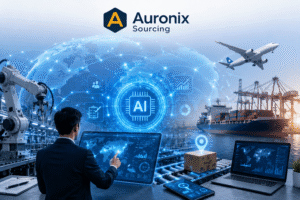
What Is AI in Global Sourcing?
Artificial Intelligence refers to computer systems that analyze large amounts of data, identify patterns, and assist with decision-making.
In global sourcing, AI can help businesses:
- Analyze market trends
- Identify product opportunities
- Compare suppliers
- Forecast demand
- Improve inventory planning
- Automate routine tasks
- Support supply chain management
AI helps businesses make faster, more informed sourcing decisions.
Why AI Matters in Product Sourcing
Traditional sourcing often involves:
- Manual supplier research
- Email communication
- Spreadsheet comparisons
- Market analysis
- Production tracking
AI helps automate many of these activities, allowing businesses to save time while improving accuracy.
1. Faster Product Research
AI-powered tools can quickly analyze large amounts of marketplace and industry data to identify:
- Growing product categories
- Consumer buying patterns
- Seasonal demand
- Popular product features
- Emerging market opportunities
This helps businesses discover promising products more efficiently.
2. Better Supplier Evaluation
AI can assist in organizing and comparing supplier information, including:
- Product catalogs
- Pricing data
- Response times
- Production capabilities
- Business profiles
However, businesses should still perform supplier verification, factory audits, and due diligence before placing orders.
3. Demand Forecasting
One of AI’s greatest strengths is analyzing historical data to identify demand patterns.
Businesses can use AI to help estimate:
- Seasonal sales trends
- Inventory requirements
- Product popularity
- Purchasing behavior
Better forecasting supports more effective inventory planning.
4. Smarter Inventory Management
AI helps businesses optimize inventory by identifying trends and improving stock planning.
Potential benefits include:
- Reduced overstock
- Lower storage costs
- Improved inventory turnover
- Better purchasing schedules
Efficient inventory management can improve cash flow and reduce waste.
5. Improved Supply Chain Visibility
Modern AI systems can help businesses monitor supply chain activity by organizing information related to:
- Production progress
- Shipment status
- Inventory movement
- Delivery timelines
Improved visibility allows businesses to respond more quickly to potential delays.
6. Faster Communication
AI-powered translation and writing tools make communication with international suppliers easier.
Businesses can use AI to:
- Draft professional emails
- Translate messages
- Summarize conversations
- Organize documentation
Clear communication helps reduce misunderstandings during sourcing.
7. Product Trend Analysis
AI can process large amounts of market data to help businesses identify:
- New product opportunities
- Changing customer preferences
- Industry developments
- Competitive product categories
Trend analysis supports better product selection and business planning.
8. Better Pricing Analysis
AI can assist businesses by comparing supplier quotations and identifying pricing patterns.
This supports:
- Cost comparisons
- Budget planning
- Supplier evaluation
- Purchase decision-making
Final negotiations should still involve direct discussions with suppliers.
9. Quality Management Support
While AI can help organize inspection reports, analyze images, and identify recurring quality issues, physical inspections remain essential.
Professional quality inspections continue to play a critical role in verifying:
- Product quality
- Workmanship
- Packaging
- Labeling
- Quantity
- Carton condition
AI complements—but does not replace—on-site quality control.
10. Smarter Business Decisions
AI provides businesses with valuable insights by combining data from multiple sources.
It can support decisions related to:
- Product selection
- Inventory planning
- Market expansion
- Supplier comparison
- Pricing strategy
Businesses that combine AI insights with experienced sourcing professionals often make stronger long-term decisions.
The Limitations of AI in Sourcing
Although AI offers many advantages, it cannot replace human expertise in every situation.
AI cannot:
- Physically inspect factories
- Verify manufacturing conditions in person
- Build supplier relationships
- Negotiate complex agreements
- Conduct on-site quality inspections
- Supervise production directly
Successful sourcing combines technology with experienced local support.
Why Human Expertise Still Matters
Even with advanced AI tools, businesses still benefit from experienced sourcing professionals who can:
- Verify suppliers
- Conduct factory audits
- Monitor production
- Resolve manufacturing issues
- Inspect products before shipment
- Coordinate logistics
Human expertise helps reduce risks that technology alone cannot eliminate.
Why Work with Auronix Sourcing?
At Auronix Sourcing, we combine modern sourcing tools with hands-on experience in China’s manufacturing industry.
Our services include:
- Product sourcing
- Supplier verification
- Factory audits
- Supplier comparison
- Price negotiation
- Product customization
- Private label manufacturing
- Sample management
- Production monitoring
- Quality inspections
- Packaging verification
- Freight coordination
- Air freight
- Sea freight
- Door-to-door logistics
By combining technology with experienced sourcing specialists, we help businesses source products more efficiently while reducing risk.
Best Practices for Using AI in Global Sourcing
To get the most value from AI:
- Use AI to research products and market trends.
- Compare multiple suppliers before making decisions.
- Always verify manufacturers independently.
- Request product samples.
- Conduct professional quality inspections.
- Build long-term supplier relationships.
- Combine AI insights with human expertise.
- Continue monitoring market changes.
These practices help businesses improve efficiency while maintaining quality and reliability.
Conclusion
Artificial Intelligence is reshaping global sourcing by helping businesses research products, analyze market trends, evaluate suppliers, forecast demand, and improve supply chain efficiency. AI-powered tools can save time, organize information, and support smarter decision-making, making them valuable assets for importers and growing brands.
However, successful sourcing still depends on reliable suppliers, thorough due diligence, quality inspections, and strong supplier relationships. AI works best as a decision-support tool rather than a replacement for experienced sourcing professionals.
With Auronix Sourcing as your trusted sourcing partner, you benefit from the perfect combination of modern technology and local expertise. From supplier verification and factory audits to quality inspections, private label manufacturing, and international shipping, we help businesses source products from China safely, efficiently, and with confidence.