
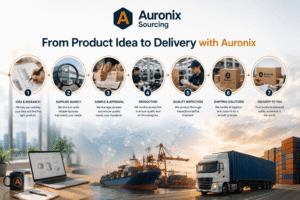
Turning a product idea into a finished product involves much more than finding a factory. Businesses need to transform their concept into clear specifications, identify suitable manufacturers, verify suppliers, develop samples, monitor production, control quality, finalize packaging, and coordinate international shipping.
When these stages are managed separately, communication gaps and unexpected problems can occur. A structured sourcing process provides greater visibility from the initial idea through final delivery.
Auronix Sourcing supports businesses throughout this journey by coordinating critical sourcing, manufacturing, quality-control, and logistics stages in China.
Step 1: Understanding the Product Idea
Every sourcing project begins with understanding what the business wants to create.
Some clients already have detailed specifications, while others may have a reference product, sketches, photographs, packaging ideas, or basic requirements.
Important details can include:
- Product type
- Materials
- Dimensions
- Features
- Target quality
- Estimated order quantity
- Branding requirements
- Packaging
- Target cost
- Destination market
Clear requirements make it easier to identify suitable factories and obtain meaningful quotations.
Step 2: Finding Suitable Manufacturers
Once the product requirements are defined, the next stage is identifying manufacturers capable of producing the product.
China has extensive manufacturing clusters specializing in different industries and production processes.
Auronix can research potential suppliers based on manufacturing experience, product capabilities, minimum order quantities, production capacity, customization options, lead times, and commercial terms.
The goal is not simply to collect the largest number of quotations. It is to identify factories that appear suitable for the specific project.
Step 3: Supplier Verification
Before committing significant capital, potential suppliers should be evaluated.
Supplier verification can include reviewing available business information, manufacturing activities, factory location, production capability, relevant documentation, certifications where applicable, and production capacity.
Businesses should also understand whether they are dealing directly with a manufacturer or through another supplier structure.
For larger or strategically important projects, a factory audit or physical visit can provide additional visibility into actual operations.
Step 4: Quotation Comparison and Negotiation
Supplier quotations should be compared carefully.
A lower price may reflect differences in materials, components, manufacturing methods, packaging, or quality expectations.
Auronix can help coordinate quotations based on clearly defined requirements so businesses can make more meaningful comparisons.
Negotiations may cover:
- Unit pricing
- Minimum order quantities
- Tooling
- Sample costs
- Packaging
- Payment terms
- Production lead times
- Customization
The objective is to establish commercially practical terms without compromising essential product requirements.
Step 5: Sample Development
Samples are the bridge between a product idea and mass production.
Auronix can coordinate sample development with the selected manufacturer.
During sampling, businesses can evaluate materials, dimensions, functionality, construction, colors, finishes, branding, accessories, and packaging.
For OEM, ODM, or private-label products, several revisions may be necessary.
Each requested change should be documented clearly until the product reaches an acceptable final version.
Step 6: Final Sample Approval
Mass production should ideally begin only after the final product requirements have been confirmed.
The approved sample becomes an important manufacturing reference.
Written specifications should support the sample and include important requirements that may not be obvious through visual comparison alone.
This creates clearer expectations for the factory and provides a stronger basis for later quality inspection.
Step 7: Packaging and Private-Label Development
For branded products, packaging is part of the customer experience.
Auronix can coordinate private-label requirements such as:
- Product logos
- Custom colors
- Printed boxes
- Labels
- Barcodes
- Product inserts
- Accessories
- Master cartons
Packaging should balance branding requirements with practical transportation needs.
An attractive retail package still needs sufficient protection to survive international handling and shipping.
Step 8: Confirming Mass Production
Once the sample, specifications, packaging, quantities, pricing, and commercial terms are confirmed, the project can move into mass production.
Important details should be documented before manufacturing begins.
These can include product quantities, approved specifications, packaging requirements, production timeline, inspection expectations, and payment terms.
Clear documentation reduces the risk of misunderstandings after production has started.
Step 9: Production Monitoring
Businesses should maintain visibility while their products are being manufactured.
Auronix can coordinate with factories throughout production and track important milestones.
Production monitoring may include:
- Raw material preparation
- Production start
- Manufacturing progress
- Potential delays
- Quality concerns
- Packaging progress
- Expected completion date
If a problem appears during manufacturing, early communication can provide more time to address it.
This is especially important when products are required for seasonal sales, launches, or inventory replenishment.
Step 10: Quality Inspection
Completing production does not automatically mean products are ready to ship.
Quality inspection provides an opportunity to evaluate finished goods against approved requirements.
Depending on the product and project, inspection may check quantity, workmanship, measurements, appearance, basic functionality where appropriate, colors, branding, accessories, packaging, and labeling.
If defects or specification differences are identified, findings can be documented and communicated with the supplier.
Corrective action or reinspection may be required depending on the severity of the issue.
Step 11: Packaging Verification
Before international transportation, packaging should receive final attention.
Auronix can help verify master cartons, protective materials, units per carton, carton dimensions, retail packaging, labels, barcodes, and shipping marks.
Packaging verification helps ensure that products are prepared according to agreed requirements and appropriately protected for transportation.
This step can reduce the risk of receiving correctly manufactured products that have been damaged because of inadequate packaging.
Step 12: Consolidating Multiple Supplier Orders
Some businesses develop product ranges requiring several different factories.
Instead of managing every supplier and shipment independently, Auronix can coordinate multiple orders and, where practical, arrange consolidation before international shipping.
Consolidation can be useful for ecommerce brands, wholesalers, retailers, and importers purchasing several product categories.
Whether it is economical depends on supplier locations, shipment volumes, timing, and handling requirements.
Step 13: Selecting the Shipping Method
Once products are ready, the appropriate shipping method can be selected according to cargo size, destination, urgency, and budget.
Common options include:
Sea Freight
Often suitable for larger commercial shipments where longer transit times are acceptable.
Air Freight
Useful for faster transportation or time-sensitive inventory.
Express Shipping
Commonly used for samples and smaller shipments.
Sea shipments may use LCL or FCL depending on cargo volume.
DDP arrangements may also be available in appropriate circumstances, although businesses should understand exactly what the quoted service includes.
Step 14: Shipping Documentation and Customs
International shipments require accurate documentation.
Depending on the shipment, documents may include commercial invoices, packing lists, bills of lading, air waybills, certificates of origin where applicable, and product-specific documentation.
Customs duties, taxes, certifications, labeling requirements, and import regulations vary according to the product and destination country.
Businesses should verify applicable requirements with relevant authorities, customs professionals, or qualified compliance specialists when necessary.
Step 15: International Delivery
The final stage is moving products from China through international transportation and destination logistics.
A successful delivery depends on the work completed throughout the earlier sourcing stages.
A verified supplier reduces manufacturing uncertainty. Approved samples establish expectations. Production monitoring improves visibility. Quality inspection identifies potential defects. Packaging verification protects products, while proper logistics planning helps move inventory efficiently.
Each stage contributes to the final result.
Reducing Risk Throughout the Process
International sourcing always involves some level of risk.
The objective is to identify and manage potential problems before they become expensive.
A structured process can combine:
- Supplier verification
- Factory audits
- Sample approval
- Clear specifications
- Production monitoring
- Quality inspection
- Packaging verification
- Shipping coordination
These controls provide businesses with greater visibility throughout the supply chain.
The Auronix Sourcing Approach
Auronix Sourcing provides local coordination in China for businesses developing, sourcing, and importing products.
Rather than focusing on only one stage, Auronix can support the complete sourcing journey—from identifying factories and coordinating samples to monitoring production, inspecting products, verifying packaging, consolidating orders, and arranging international shipping.
This connected approach can be particularly valuable for businesses that do not have their own sourcing team physically located in China.
Conclusion
Transforming a product idea into inventory ready for customers requires coordination across many different stages.
Businesses need suitable factories, verified suppliers, approved samples, clear manufacturing specifications, controlled production, quality inspection, reliable packaging, and appropriate international logistics.
Skipping important steps may save time initially but can create larger problems later.
With Auronix Sourcing, businesses can manage the journey from product idea to international delivery through a more structured sourcing process, with local coordination across manufacturing and supply chain activities in China.
The result is greater visibility at every critical stage—from the first product concept to the moment finished goods begin their journey to the destination market.