
Barcodes are an essential part of international trade and modern supply chains. They enable manufacturers, retailers, warehouses, customs authorities, and logistics companies to identify, track, and manage products accurately throughout the shipping process. Without the correct barcode labeling, exporters may face shipment delays, warehouse rejections, inventory errors, or additional costs.
Whether you’re an Amazon FBA seller, Shopify store owner, wholesaler, retailer, distributor, or private label brand, understanding barcode requirements is crucial before exporting products from China.
At Auronix Sourcing, we help businesses prepare export-ready products by coordinating supplier verification, product labeling, packaging, quality inspections, and international shipping. We ensure products are correctly labeled before they leave the factory.
This guide explains barcode requirements for exporting products from China and how to avoid common labeling mistakes.
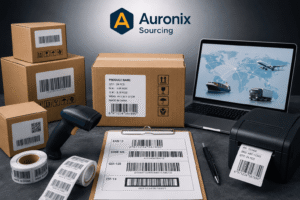
What Is a Product Barcode?
A barcode is a machine-readable code that contains product identification information.
It allows businesses to:
- Identify products
- Track inventory
- Improve warehouse efficiency
- Speed up checkout processes
- Reduce manual errors
- Manage global supply chains
Barcodes are used throughout manufacturing, shipping, customs clearance, warehousing, and retail.
Why Barcodes Are Important for Exporting
Proper barcode labeling helps:
- Improve inventory management
- Simplify warehouse operations
- Reduce shipping errors
- Support customs processing
- Improve product traceability
- Meet retailer and marketplace requirements
Many international retailers and fulfillment centers require products to have scannable barcodes before accepting shipments.
Common Types of Barcodes
Different industries and sales channels may require different barcode formats.
UPC (Universal Product Code)
Commonly used for:
- Retail products
- Supermarkets
- Consumer goods
- North American markets
UPC barcodes are widely accepted by retailers and online marketplaces.
EAN (European Article Number)
Commonly used for:
- International retail
- European markets
- Consumer products
EAN barcodes are recognized in many countries worldwide.
Code 128
Frequently used for:
- Logistics
- Warehousing
- Shipping labels
- Internal inventory systems
QR Codes
Often used for:
- Product information
- Marketing campaigns
- Warranty registration
- User manuals
- Product authentication
QR codes usually complement product barcodes rather than replace them.
Obtain Legitimate Barcode Numbers
For products sold through major retailers or global marketplaces, barcode numbers should come from a recognized barcode authority.
Using properly licensed barcode numbers helps ensure compatibility with retailer systems and improves product traceability.
One Barcode Per Product Variation
Each unique product variation should have its own barcode.
Examples include differences in:
- Size
- Color
- Model
- Capacity
- Packaging configuration
Using separate barcodes for each variation helps prevent inventory confusion.
Barcode Placement Guidelines
Proper placement improves scanning accuracy.
Place barcodes:
- On a flat surface
- Away from folds or seams
- In a clearly visible location
- With sufficient spacing around the code
- Where scanners can easily access them
Avoid placing barcodes over package edges or curved surfaces whenever possible.
Barcode Print Quality
Poor print quality can lead to scanning failures.
Check that:
- Lines are sharp and clear
- Contrast is high
- Printing is not blurred
- Labels are securely attached
- No damage covers the barcode
Testing sample labels before production helps prevent problems later.
Product Labels May Include Additional Information
Depending on your product and destination market, labels may also contain:
- Product name
- Brand name
- Model number
- Batch number
- Country of origin
- Safety warnings (where required)
- Manufacturing date
- Expiration date (where applicable)
Always confirm destination market requirements before printing labels.
Barcode Requirements for Amazon FBA
Amazon FBA shipments often require additional labeling beyond the manufacturer’s barcode.
Depending on the fulfillment method, products may require:
- Amazon FNSKU labels
- Carton labels
- Shipping labels
Ensure products are prepared according to Amazon’s current packaging and labeling requirements before shipment.
Barcode Requirements for Wholesale and Retail
Retail chains and wholesale buyers may have their own barcode standards.
They may specify:
- Barcode type
- Label size
- Placement location
- Packaging format
- Carton labeling requirements
Always confirm buyer-specific requirements before production begins.
Verify Barcodes Before Shipment
Before products leave the factory:
- Scan every barcode
- Verify product information
- Confirm barcode placement
- Check print quality
- Inspect packaging labels
- Ensure consistency across production batches
Testing reduces the risk of shipment delays and warehouse rejections.
Common Barcode Mistakes
Many businesses experience problems because they:
- Reuse the same barcode for multiple product variations
- Print low-quality labels
- Place labels in difficult-to-scan locations
- Forget marketplace-specific labeling requirements
- Skip barcode testing before shipment
Avoiding these mistakes improves supply chain efficiency and reduces costly errors.
Why Work with Auronix Sourcing?
Preparing products for export involves more than manufacturing—it requires accurate labeling, quality control, and careful shipment preparation.
At Auronix Sourcing, we help businesses ensure their products are export-ready before they leave China.
Our services include:
- Product sourcing
- Supplier verification
- Factory audits
- Product labeling coordination
- Barcode verification
- Packaging development
- Private label manufacturing
- Sample management
- Production monitoring
- Quality inspections
- Packaging verification
- Freight coordination
- Air freight
- Sea freight
- Door-to-door logistics
Our experienced sourcing team works closely with verified manufacturers to ensure products are correctly labeled, professionally packaged, and prepared for smooth international distribution.
Best Practices for Barcode Compliance
To ensure successful exports:
- Use legitimate barcode numbers.
- Assign a unique barcode to each product variation.
- Confirm retailer or marketplace requirements.
- Print high-quality barcode labels.
- Place barcodes where they are easy to scan.
- Test barcode readability before shipment.
- Verify labeling during quality inspections.
- Keep barcode records organized for future inventory management.
Following these practices helps reduce shipping delays, inventory errors, and compliance issues.
Conclusion
Correct barcode labeling is a critical part of preparing products for export. From inventory management and customs processing to warehouse operations and retail sales, accurate barcodes help products move efficiently through the global supply chain.
By choosing the appropriate barcode type, labeling products correctly, verifying print quality, and meeting customer or marketplace requirements, businesses can avoid costly delays and improve operational efficiency.
With Auronix Sourcing as your trusted sourcing partner, you receive complete support in product sourcing, supplier verification, factory audits, barcode coordination, packaging solutions, quality inspections, and international shipping—helping your business export products from China accurately, efficiently, and with confidence.