
Approving a product sample can feel like the final step before manufacturing begins.
In reality, it is the beginning of one of the most important stages of the sourcing process.
Between production approval and mass production, the factory must convert an approved sample, specification, or prototype into a repeatable manufacturing system capable of producing hundreds, thousands, or even tens of thousands of consistent units.
Materials need to be confirmed. Components must be ordered. Packaging files may need final approval. Production instructions have to be prepared. Machinery, tooling, workers, and quality standards must all be aligned.
If these steps are poorly managed, a perfect approved sample can still become a disappointing bulk order.
Understanding what happens during this transition helps importers maintain control before large-scale production begins.
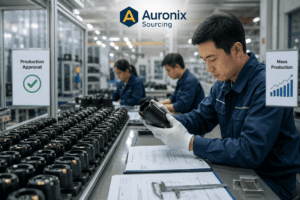
The Approved Sample Becomes the Production Reference
Once the buyer approves the final sample, that version should become an important reference for mass production.
The supplier should not continue making uncontrolled changes.
The approved product may establish expectations for:
- Materials
- Dimensions
- Colors
- Components
- Functionality
- Surface finish
- Branding
- Packaging
Where appropriate, the buyer and supplier should clearly identify which sample or specification revision represents final approval.
Without version control, different teams may accidentally work from outdated information.
Final Specifications Are Locked
Before mass production, the factory needs a clear production specification.
This documentation can include:
- Technical drawings
- Dimensions and tolerances
- Material specifications
- Color references
- Component requirements
- Printing details
- Packaging instructions
This stage is sometimes referred to as specification freezing or design freeze.
Changes after this point can affect cost, tooling, materials, production schedules, and quality.
Importers should therefore avoid unnecessary last-minute revisions.
The Purchase Order Is Confirmed
The commercial order should also be clearly documented.
Important information may include:
- Product model
- Quantity
- Unit price
- Variants
- Packaging
- Production lead time
- Payment terms
- Shipping terms
For products with several colors or sizes, the exact quantity of each SKU should be confirmed.
A small mistake in the quantity breakdown can become a large inventory problem after thousands of units are produced.
The Factory Reviews Manufacturability
Even after sample approval, the factory may conduct an internal production review.
The engineering and production teams need to determine whether the approved design can be manufactured consistently at scale.
They may review:
- Tooling
- Assembly sequence
- Production speed
- Material behavior
- Critical tolerances
- Potential bottlenecks
A handcrafted prototype and a mass-produced product are not always identical manufacturing challenges.
The goal is to make the approved result repeatable.
Raw Materials Are Ordered
Once the order and specifications are confirmed, the factory can begin purchasing required materials.
These may include:
- Plastics
- Metals
- Fabrics
- Electronic components
- Hardware
- Packaging materials
Material purchasing can represent a significant portion of the production lead time.
Factories may already stock standard materials, while customized materials may require separate production and higher minimum quantities.
This is one reason buyers should avoid changing specifications after materials have been ordered.
Components Are Secured
Many factories do not manufacture every component themselves.
A finished product may depend on several upstream suppliers providing items such as:
- Motors
- Batteries
- PCBs
- Fasteners
- Displays
- Zippers
- Packaging
The final assembly factory must coordinate these suppliers before production can proceed smoothly.
A delay from one critical component supplier can delay the entire order.
Incoming Materials May Be Inspected
Good quality control begins before final products exist.
Factories may perform Incoming Quality Control (IQC) on raw materials and purchased components.
Depending on the product, checks may involve:
- Dimensions
- Appearance
- Material specifications
- Component functionality
- Quantity
Catching incorrect materials before production is much cheaper than discovering the problem after thousands of products have been assembled.
Tooling Is Prepared
Products requiring custom molds, dies, jigs, fixtures, or other tooling need additional preparation.
Before production begins, the factory may:
- Install molds
- Adjust tooling
- Prepare fixtures
- Calibrate equipment
- Conduct trial runs
Tooling condition matters.
A sample produced from carefully adjusted tooling does not guarantee that every production unit will automatically match it.
Process setup must be controlled.
Packaging Moves Into Production
Custom packaging often has its own manufacturing timeline.
After artwork approval, packaging suppliers may begin producing:
- Retail boxes
- Printed inserts
- Labels
- Stickers
- Protective inserts
- Master cartons
Packaging should be treated as part of the product specification rather than something added at the end.
Incorrect packaging dimensions, weak protection, or printing mistakes can delay shipment even when the product itself is complete.
Production Instructions Are Prepared
The people who developed the sample may not be the same workers who assemble the bulk order.
That creates an important challenge:
How does the factory transfer the approved requirements from development into production?
Production teams may require instructions covering:
- Assembly sequence
- Component placement
- Workmanship standards
- Critical dimensions
- Testing procedures
- Packaging
Clear instructions reduce dependence on individual memory.
Quality Standards Are Confirmed
Before production, buyer and supplier should understand what will be considered acceptable.
Quality requirements may cover:
- Materials
- Dimensions
- Functionality
- Cosmetic appearance
- Workmanship
- Branding
- Packaging
For suitable products, measurable tolerances and inspection criteria should be documented.
Statements such as “make it high quality” are too subjective for effective quality control.
A Pre-Production Meeting May Be Held
For larger or more complex orders, the factory may conduct a pre-production meeting.
Relevant teams can review:
- Approved specifications
- Production schedule
- Quality requirements
- Packaging
- Known technical risks
This helps ensure that sales, engineering, purchasing, production, and quality-control teams are working from the same requirements.
Miscommunication between departments can otherwise create avoidable production errors.
A Production Schedule Is Created
Factories typically manage many customer orders simultaneously.
Your order needs to be assigned production capacity.
The schedule may depend on:
- Material arrival
- Machine availability
- Tooling availability
- Labor
- Existing orders
- Production complexity
This is why a quoted lead time does not necessarily mean manufacturing starts immediately after payment.
Part of the lead time may be spent preparing materials and waiting for the scheduled production slot.
A Pilot or Initial Production Run May Be Used
For some products, particularly new or customized ones, beginning immediately with the entire quantity can create unnecessary risk.
A small initial production run may help confirm that the manufacturing process produces the expected result consistently.
This can expose issues involving:
- Assembly
- Tolerances
- Appearance
- Functionality
- Production efficiency
Problems discovered at this stage may be corrected before the full order is manufactured.
The First Production Units Matter
The first units coming off the production line can provide important information.
They help show whether the factory successfully transferred the approved specification into mass production.
These units can be checked against:
- Approved sample
- Technical specifications
- Quality requirements
If there is a major discrepancy, correcting it early can prevent the same defect from being repeated across thousands of units.
Mass Production Begins
Once materials, tooling, instructions, quality standards, and production setup are ready, the factory can move into full-scale manufacturing.
The process may involve:
Material Preparation → Component Production → Assembly → In-Process Checks → Final Assembly → Testing → Packaging
The exact sequence depends on the product.
At this stage, consistency becomes the primary objective.
Producing one excellent sample is different from producing 10,000 acceptable units repeatedly.
Quality Control Should Continue During Production
Quality control should not exist only at the end.
Depending on the product and risk level, production monitoring may include checks during manufacturing.
This can help detect:
- Wrong components
- Assembly mistakes
- Cosmetic defects
- Dimensional problems
- Process variation
Early detection reduces the quantity of defective products produced before corrective action begins.
Production Progress Should Be Monitored
Importers should not assume everything is progressing simply because the factory says:
“Production is going well.”
Useful progress information may include:
- Material status
- Production start date
- Percentage completed
- Packaging status
- Expected completion date
For important orders, independent production monitoring may provide additional visibility.
Final Inspection Comes Later
Once most or all production is completed and appropriately packed, a final inspection may be performed before shipment.
Depending on the inspection plan, checks can cover:
- Quantity
- Workmanship
- Dimensions
- Functionality
- Branding
- Packaging
The inspection result can then support the buyer’s shipment decision according to the agreed commercial arrangement.
Quality requirements and inspection expectations should be established before production—not invented after defects appear.
Why Approved Samples Still Become Bad Bulk Orders
One of the biggest misconceptions in sourcing is:
“The sample was perfect, so production will be perfect.”
That assumption can fail because mass production introduces variables that sample development does not fully represent.
Problems can come from:
- Different material batches
- Component variation
- Incorrect machine settings
- Worker inconsistency
- Supplier substitutions
- Poor process control
- Miscommunication
This is why sample approval and production control are separate stages.
Avoid Unauthorized Changes
Factories should not substitute materials, components, or processes without appropriate buyer approval when those changes affect agreed specifications.
For example, changing a component to reduce cost may alter:
- Performance
- Durability
- Appearance
- Compliance
Important specifications should therefore be documented clearly.
The buyer should also establish how proposed production changes are communicated and approved.
How Auronix Sourcing Manages the Transition to Mass Production
Auronix Sourcing helps businesses manage the critical transition between approved product development and full-scale manufacturing.
The process can include final specification confirmation, supplier coordination, sample approval management, material and component follow-up, production scheduling, packaging coordination, factory visits, production monitoring, quality inspection, shipment consolidation, and international shipping coordination.
For customized OEM and ODM projects, Auronix can also help maintain communication between buyers, suppliers, production teams, and quality-control personnel so that the approved product requirements are carried into mass production as accurately as possible.
Conclusion
The period between production approval and mass production is not an empty waiting period.
It is when the factory transforms an approved product into a repeatable manufacturing process.
Specifications are finalized, materials and components are secured, tooling is prepared, packaging enters production, quality standards are confirmed, production instructions are created, and manufacturing capacity is scheduled.
Each step can influence the final result.
A successful sample proves that a factory can make the product once. Effective production management helps determine whether it can make that product consistently at scale.
With Auronix Sourcing, businesses can manage the transition from approved sample to mass production through supplier coordination, production monitoring, quality control, packaging management, and international logistics—helping ensure that what was approved before production is what ultimately reaches the market.