
Finding factories in China is not difficult. Finding the right factory for a specific product, quality standard, order quantity, and business model requires a much more structured approach.
Thousands of manufacturers operate across China’s major industrial regions, producing everything from consumer electronics and home products to packaging, textiles, machinery, beauty accessories, and private-label goods. The challenge for importers is determining which suppliers genuinely have the manufacturing capability, capacity, quality systems, and experience required for their project.
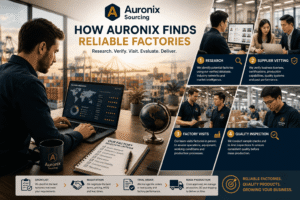
At Auronix Sourcing, factory sourcing goes beyond collecting quotations. The process focuses on identifying suitable manufacturers, evaluating their capabilities, verifying important information, comparing commercial terms, managing samples, and reducing sourcing risks before mass production begins
Understanding the Buyer’s Requirements
Every successful factory search begins with a clear product brief.
Before approaching manufacturers, Auronix Sourcing works from key requirements such as:
- Product specifications
- Materials
- Dimensions and functionality
- Target order quantity
- Target pricing
- Quality expectations
- Required customization
- OEM or ODM requirements
- Private-label needs
- Packaging requirements
- Expected production lead time
- Destination-market requirements
This step is important because a reliable factory for one buyer may not necessarily be suitable for another.
A large manufacturer may have excellent production capabilities but require minimum order quantities that are unsuitable for a smaller brand. Similarly, a low-cost factory may not have the equipment or quality systems required for a premium product.
Searching Across Multiple Supplier Channels
Relying on a single supplier directory can limit the available options.
Depending on the product, potential manufacturers can be identified through different sourcing channels, industry networks, manufacturing clusters, supplier databases, trade resources, and existing factory connections.
China has developed specialized manufacturing regions for many product categories. Understanding where particular products are commonly manufactured can make the sourcing process more efficient.
The objective is to develop a shortlist of relevant suppliers rather than sending inquiries to large numbers of unrelated companies.
Identifying Manufacturers With Relevant Experience
Product experience matters.
A factory already manufacturing similar products may understand the materials, production processes, tolerances, tooling, quality requirements, and common manufacturing challenges involved.
Auronix evaluates whether potential suppliers appear to have relevant production experience before moving deeper into negotiations.
This can be particularly important for:
- Customized products
- Private-label goods
- Products requiring molds
- Products with multiple components
- Complex packaging
- Products requiring consistent finishes
Relevant manufacturing experience can reduce the learning curve during product development.
Distinguishing Factories From Intermediaries
Supplier directories may include manufacturers, trading companies, wholesalers, and other intermediaries.
Trading companies are not automatically unsuitable. In some situations, they can provide useful access to multiple factories or specialized product categories.
However, buyers should understand who is actually manufacturing their products.
Where appropriate, Auronix investigates the supplier’s business structure and manufacturing arrangements to establish greater transparency.
For OEM, ODM, higher-volume, or technically demanding projects, understanding the actual production facility can become particularly important.
Reviewing Supplier Background Information
Before recommending a supplier for significant production, available business information should be reviewed.
This may include:
- Registered business information
- Factory location
- Business scope
- Manufacturing activities
- Product categories
- Export experience
- Relevant documentation
- Certifications where applicable
Supplier verification helps identify inconsistencies early and provides additional information for comparing shortlisted manufacturers.
Verification does not guarantee future performance, but it can reduce avoidable uncertainty before money is committed.
Evaluating Manufacturing Capability
A factory must have the capability to manufacture the required product consistently.
Depending on the project, Auronix may evaluate factors such as production equipment, manufacturing processes, assembly capabilities, quality-control procedures, packaging operations, and available production resources.
For customized products, it is also important to understand whether key processes are completed internally or subcontracted.
Subcontracting is common in many manufacturing industries and is not necessarily a problem, but buyers should understand how important production stages are managed.
Checking Production Capacity
Capacity becomes increasingly important for businesses planning to scale.
A supplier may be capable of producing an initial order but struggle when quantities increase substantially.
Where relevant, Auronix evaluates whether the factory’s production capabilities appear suitable for current requirements and potential future volumes.
Factors can include equipment, workforce, production lines, existing workload, and estimated output.
Capacity planning can reduce the risk of selecting a supplier that becomes a bottleneck as the buyer grows.
Comparing Quotations Correctly
The cheapest quotation is not automatically the best quotation.
When several factories provide significantly different prices, the underlying specifications should be compared carefully.
Price differences may result from variations in:
- Materials
- Components
- Manufacturing processes
- Quality levels
- Packaging
- Order quantities
- Customization
- Production efficiency
Auronix focuses on comparing suppliers based on equivalent requirements wherever practical.
This allows buyers to evaluate value rather than simply selecting the lowest number.
Factory Audits and Physical Visits
For larger orders, strategic suppliers, or complex manufacturing projects, a physical factory visit can provide additional visibility.
A factory assessment may examine production areas, equipment, quality-control procedures, warehouse conditions, packaging operations, capacity, and general manufacturing organization.
Factory visits can also help confirm whether the supplier’s actual operations are consistent with the information provided during initial discussions.
Having local coordination in China makes physical verification more practical when a project requires it.
Sample Development and Approval
A factory should demonstrate its capabilities through actual products, not only presentations and quotations.
Samples are therefore an important part of supplier evaluation.
Auronix can coordinate sample development and revisions while checking requirements involving materials, dimensions, functionality, workmanship, colors, finishes, branding, accessories, and packaging.
For OEM and private-label projects, several revisions may be required.
The final approved sample should be supported by documented specifications before mass production begins.
Evaluating Communication and Responsiveness
Factory communication can significantly affect the success of a production order.
During sourcing and sampling, Auronix evaluates how effectively suppliers understand technical requirements, answer questions, communicate limitations, and respond to requested changes.
Good suppliers should be willing to discuss manufacturing challenges rather than simply agreeing to every request.
Clear communication becomes particularly important when customized products involve multiple specifications and production stages.
Quality Control Before Shipment
Finding a reliable factory does not eliminate the need for quality control.
Manufacturing conditions can change between production runs, and even established suppliers can experience quality problems.
Depending on the order, quality-control procedures may include pre-production checks, during-production inspections, and pre-shipment inspections.
Inspection can verify product quantity, workmanship, measurements, functionality, appearance, packaging, labeling, and other agreed specifications.
Production Monitoring
After supplier selection, Auronix can continue coordinating with the factory throughout manufacturing.
Production monitoring can provide visibility into raw material preparation, production progress, potential delays, quality issues, packaging, and expected completion dates.
This is particularly useful when businesses have inventory deadlines or planned launches.
Identifying production problems early provides more time to develop solutions before international shipping begins.
Building Long-Term Factory Relationships
A reliable factory should ideally become part of a long-term supply chain rather than simply completing one transaction.
Supplier performance can be evaluated over repeated orders based on quality, communication, production timing, pricing consistency, packaging accuracy, and responsiveness to corrective actions.
As purchasing volumes increase, stronger supplier relationships may also create opportunities to negotiate improved commercial terms, production scheduling, packaging, or minimum order quantities.
Why Local Factory Sourcing Matters
China’s manufacturing ecosystem is extensive and geographically diverse.
Having local sourcing support can make it easier to communicate with suppliers, visit factories, coordinate samples, monitor production, inspect goods, and respond when problems require physical follow-up.
Auronix Sourcing, with team operations in Guangzhou, China, supports international businesses across the sourcing process—from identifying potential manufacturers and supplier verification to sample management, factory coordination, quality inspection, packaging verification, and shipping.
Conclusion
Finding a reliable factory requires much more than searching online and choosing the supplier with the lowest quotation.
A structured sourcing process should begin with clear product requirements and continue through supplier research, business verification, manufacturing capability assessment, quotation comparison, factory audits when appropriate, sample approval, production monitoring, and quality inspection.
At Auronix Sourcing, the goal is to help businesses identify factories that fit their actual product and supply chain requirements while providing greater visibility throughout the manufacturing process.
By combining careful factory selection with ongoing verification and quality control, businesses can build stronger supplier relationships and create a more reliable foundation for long-term sourcing from China.