
Importing products from international suppliers can provide businesses with access to competitive manufacturing, specialized production capabilities, private-label opportunities, and a wider range of products. However, international trade also introduces risks that are less common when purchasing domestically.
Supplier problems, inconsistent product quality, production delays, incorrect documentation, shipping disruptions, customs issues, unexpected costs, and regulatory requirements can all affect an importer’s profitability.
Effective risk management does not eliminate every possible problem. Instead, it helps businesses identify potential risks early, reduce their likelihood, and prepare appropriate contingency plans.
This guide explains practical strategies for managing risks throughout the import process.
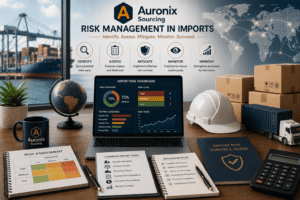
Understand the Main Import Risks
Import risks can occur at almost every stage of the supply chain.
Common categories include:
- Supplier risk
- Product quality risk
- Financial risk
- Production risk
- Compliance risk
- Packaging risk
- Shipping and logistics risk
- Customs risk
- Inventory risk
- Market and demand risk
Businesses should evaluate these risks before placing an order rather than waiting until goods have already entered production.
1. Verify Suppliers Before Ordering
Supplier verification is one of the most important risk-reduction measures in international sourcing.
A professional website or competitive quotation does not automatically confirm that a supplier has suitable manufacturing capabilities.
Importers should evaluate factors such as:
- Business registration
- Factory location
- Manufacturing capabilities
- Production equipment
- Quality management systems
- Production capacity
- Export experience
- Relevant certifications
- Product experience
For larger or strategically important orders, a factory audit can provide additional visibility into actual manufacturing operations.
2. Avoid Choosing Suppliers Only on Price
An unusually low quotation can sometimes indicate differences in materials, specifications, quality standards, or manufacturing processes.
Importers should compare quotations carefully and confirm that suppliers are pricing the same specifications.
The lowest factory price does not necessarily create the lowest total cost.
Poor-quality production can result in rework, rejected inventory, refunds, replacement shipments, and damaged customer relationships.
Supplier selection should balance cost with manufacturing capability and reliability.
3. Approve Samples Before Mass Production
Samples allow businesses to evaluate products before committing to larger quantities.
Check important details such as materials, dimensions, functionality, workmanship, colors, components, branding, and packaging.
For OEM, ODM, and private-label products, several sample revisions may be necessary.
Once the correct sample is approved, document the final specifications clearly.
The approved sample can then serve as a reference during manufacturing and quality inspection.
4. Establish Clear Purchase Agreements
Vague purchase orders increase risk.
Important commercial and technical requirements should be documented before production begins.
These may include:
- Product specifications
- Quantity
- Unit pricing
- Materials
- Packaging
- Labeling
- Production timeline
- Payment terms
- Inspection requirements
- Shipping terms
Importers should also understand Incoterms such as EXW, FOB, and DDP because they affect responsibilities between buyers and sellers.
Clear agreements reduce misunderstandings and create better accountability.
5. Monitor Production
Production delays can affect inventory, marketing campaigns, customer commitments, and freight costs.
Importers should monitor important manufacturing milestones instead of waiting until the expected completion date.
Production monitoring can track raw material preparation, manufacturing progress, quality issues, packaging status, and expected completion.
Early identification of delays gives businesses more time to adjust inventory and logistics plans.
6. Implement Quality Inspection
Quality inspection is a critical part of import risk management.
Depending on the product and order value, businesses may use:
Pre-Production Inspection
Verify important materials and components before mass production.
During-Production Inspection
Check products while manufacturing is underway to identify problems earlier.
Pre-Shipment Inspection
Inspect completed products before shipment.
Inspection can verify quantities, workmanship, measurements, functionality, appearance, packaging, labeling, and agreed specifications.
Businesses should avoid assuming that previous successful orders guarantee future quality.
7. Verify Packaging Before Shipment
A correctly manufactured product can still become unsellable if packaging fails during international transportation.
Packaging verification should evaluate retail packaging, product protection, master carton strength, carton quantities, barcodes, labels, and shipping marks.
Fragile or sensitive products may require additional protection.
Businesses should also verify any destination-market packaging and labeling requirements that apply to their products.
8. Manage Product Compliance Risk
Product regulations vary according to the product category and destination country.
Certain goods may require testing, certification, labeling, documentation, registrations, or specific safety standards.
Importers should identify applicable requirements before placing mass-production orders.
Requirements can differ significantly between markets, so businesses should consult relevant authorities or qualified compliance professionals when necessary.
Ignoring compliance can lead to customs delays, rejected shipments, recalls, penalties, or restrictions on selling the product.
9. Reduce Shipping and Logistics Risk
International freight can experience delays caused by port congestion, weather, capacity shortages, documentation issues, or other disruptions.
Businesses should select freight options according to shipment urgency, size, value, and risk.
Cargo insurance may also be appropriate depending on the shipment and commercial terms.
Important documents should be checked before departure to reduce avoidable customs problems.
Businesses should also understand the responsibilities assigned under their chosen Incoterm.
10. Plan for Customs and Landed Costs
Unexpected import costs can damage product profitability.
Before ordering, estimate total landed cost rather than focusing exclusively on factory price.
Potential expenses include freight, insurance, customs duties, taxes, clearance charges, inspections, port charges, warehousing, and final delivery.
Customs duties and import requirements depend on product classification and destination country.
Accurate documentation and appropriate product classification are important for smoother customs clearance.
11. Protect Against Inventory Risk
Long international lead times make inventory planning especially important.
Stockouts can result in lost sales, while excessive inventory can tie up cash and increase storage expenses.
Businesses should calculate reorder points using sales demand, manufacturing lead times, shipping times, customs clearance, and safety-stock requirements.
Maintaining appropriate safety stock can provide protection against temporary production or shipping delays.
12. Avoid Dependence on One Supplier
Single-supplier dependency can create significant vulnerability.
If an important factory experiences capacity problems, quality failures, or production disruption, the buyer may have no immediate alternative.
For critical products, businesses should consider identifying and evaluating backup suppliers.
Alternative suppliers should ideally be verified and sampled before they are urgently needed.
This creates greater supply chain resilience.
Common Import Risk Management Mistakes
Common mistakes include paying suppliers without adequate verification, skipping samples, using unclear specifications, failing to inspect products, ignoring compliance requirements, relying on one supplier, and purchasing without calculating landed cost.
Another mistake is reacting to risks only after problems occur.
Effective risk management should be built into supplier selection, manufacturing, quality control, logistics, and inventory planning from the beginning.
How Auronix Sourcing Supports Risk Reduction
Managing overseas manufacturing risks can be difficult when businesses cannot regularly visit suppliers themselves.
Auronix Sourcing supports businesses sourcing from China through supplier identification and verification, factory audits and visits, sample management, production monitoring, quality inspection, packaging verification, consolidation, and international shipping coordination.
Having local visibility can help businesses identify potential supplier, production, quality, and packaging issues before goods leave the manufacturing country.
Conclusion
Risk is an unavoidable part of international trade, but many import problems can be reduced through preparation and structured supply chain management.
Businesses should verify suppliers, approve samples, document specifications, monitor production, inspect goods, verify packaging, understand compliance requirements, plan logistics carefully, and maintain appropriate inventory strategies.
Import risk management should not be treated as a single inspection or checklist. It is an ongoing process covering the entire supply chain.
By identifying vulnerabilities early and creating contingency plans, importers can build more reliable, resilient, and scalable international sourcing operations.